Biometrics · Deep Learning · Touchless Recognition

PalmNet

Deep learning for highly usable palmprint biometrics, designed for less-constrained acquisitions and heterogeneous devices.

The project

Touchless palmprint recognition with adaptive deep features

Touchless palmprint recognition systems enable high-accuracy recognition of individuals through less-constrained and highly usable procedures that do not require contact of the palm with a surface.

Palmprint segmentation and ROI extraction
CNN-based palmprint representation
Learned Gabor-PCA filters for palmprint descriptors

Touchless palmprint recognition systems enable high-accuracy recognition of individuals through less-constrained and highly usable procedures that do not require the contact of the palm with a surface. To perform this recognition, methods based on local texture descriptors and Convolutional Neural Networks (CNNs) are currently used to extract highly discriminative features while compensating for variations in scale, rotation, and illumination in biometric samples. In particular, the main advantage of CNN-based methods is their ability to adapt to biometric samples captured with heterogeneous devices. However, the current methods rely on either supervised training algorithms, which require class labels (e.g., the identities of the individuals) during the training phase, or filters pretrained on general-purpose databases, which may not be specifically suitable for palmprint data.

Another advantage of touchless palmprint recognition is that with a palmar hand acquisition, it is possible to extract the palmprint as well as the Inner Finger Texture (IFT) and increase the recognition accuracy without requiring further biometric acquisitions. However, current methods based on Deep Learning (DL) do not consider the fusion of palmprint with IFT.

The method

PalmNet: Gabor-PCA Convolutional Networks

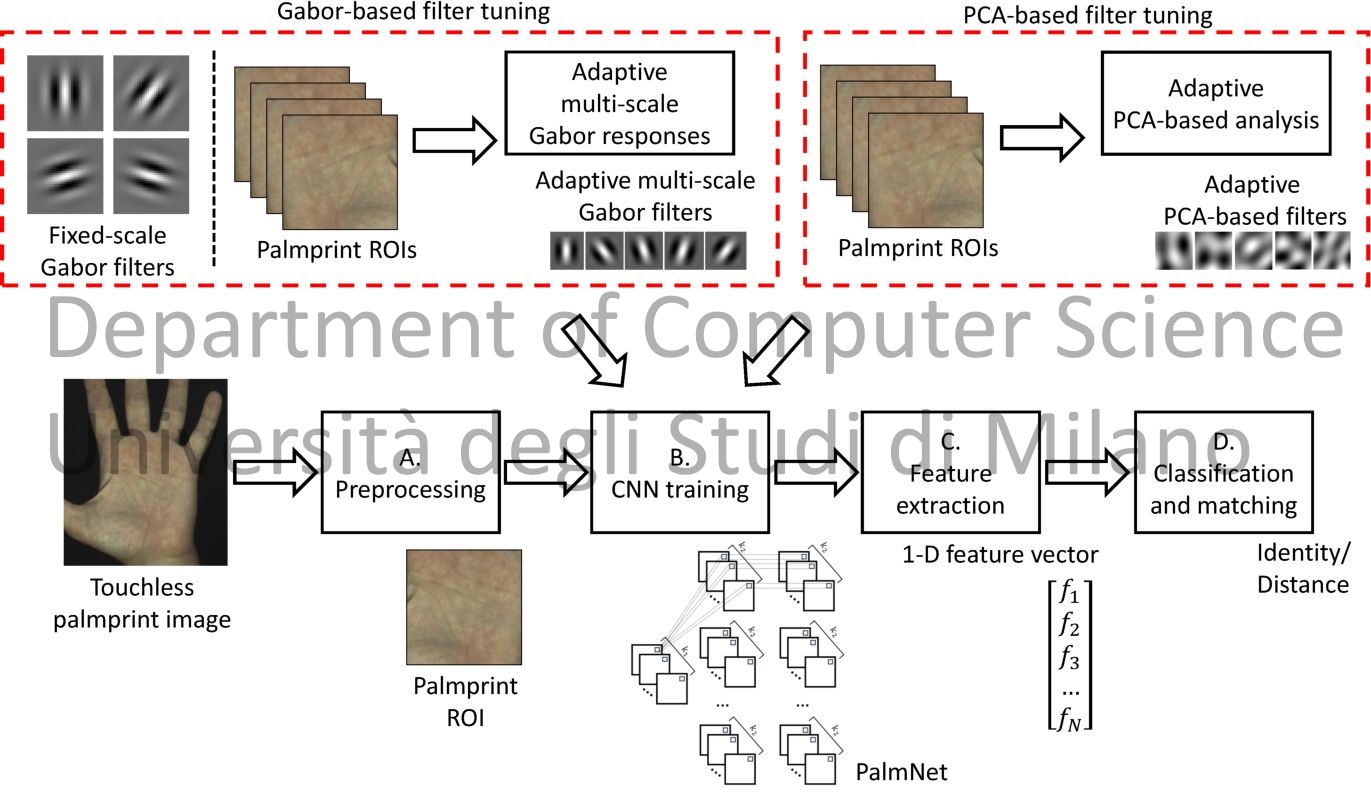
PalmNet tunes palmprint-specific filters through an unsupervised procedure based on Gabor responses and Principal Component Analysis, without requiring class labels during training.

Touchless hand acquisition

🧭

Palmprint preprocessing

🌀

Gabor-PCA filter tuning

🧠

CNN feature extraction

🎯

Matching

PalmNet method outline

Palmprint-specific descriptors

To achieve a high recognition accuracy with touchless palmprint samples captured using different devices while neither requiring class labels for training nor using pretrained filters, we introduce PalmNet, which is a novel CNN that uses a newly developed method to tune palmprint-specific filters through an unsupervised procedure based on Gabor responses and Principal Component Analysis (PCA), not requiring class labels during training. PalmNet is a new method of applying Gabor filters in a CNN and is designed to extract highly discriminative palmprint-specific descriptors and to adapt to heterogeneous databases.

The method

FusionNet: Touchless Palmprint and Finger Texture Recognition: A Deep Learning Fusion Approach

FusionNet performs the fusion of palmprint and IFT using a single hand acquisition.

✂️

Segmentation

🧠

CNN training

🔍

Feature extraction

🔗

Fusion

Classification and matching

Palmprint-specific fusion

We propose the first novel method in the literature based on a CNN to perform the fusion of palmprint and IFT using a single hand acquisition. Our approach uses an innovative procedure based on training the same CNN topology separately on the palmprint and the IFT, adapting the neural model to the different biometric traits, and then performing a feature-level fusion.

FusionNet method outline

Publications

PalmNet: Gabor-PCA Convolutional Networks for Touchless Palmprint Recognition

A. Genovese, V. Piuri, K. N. Plataniotis, and F. Scotti, IEEE Transactions on Information Forensics and Security, vol. 14, no. 2, December 2019, pp. 3160-3174. ISSN: 1556-6013.

Touchless Palmprint and Finger Texture Recognition: A Deep Learning Fusion Approach

A. Genovese, V. Piuri, F. Scotti, and S. Vishwakarma, Proc. of the 2019 IEEE International Conference on Computational Intelligence and Virtual Environments for Measurement Systems and Applications, Tianjin, China, June 14-16, 2019, pp. 1-6. ISBN: 978-1-5386-8344-6.

Cite this work

@Article{tifs19,
  author  = {A. Genovese and V. Piuri and K. N. Plataniotis and F. Scotti},
  title   = {PalmNet: Gabor-PCA Convolutional Networks for touchless palmprint recognition},
  journal = {IEEE Transactions on Information Forensics and Security},
  volume  = {14},
  number  = {2},
  pages   = {3160-3174},
  month   = {December},
  year    = {2019},
  note    = {1556-6013}
}
@InProceedings{civemsa19,
  author    = {A. Genovese and V. Piuri and F. Scotti and S. Vishwakarma},
  booktitle = {Proc. of the 2019 IEEE Int. Conf. on Computational Intelligence
               and Virtual Environments for Measurement Systems and Applications
               (CIVEMSA 2019)},
  title     = {Touchless palmprint and finger texture recognition: A Deep Learning fusion approach},
  address   = {Tianjin, China},
  month     = {June},
  day       = {14-16},
  year      = {2019},
  pages     = {1-6}
}

Acknowledgements

This work was supported in part by the Italian Ministry of Research as part of the MIUR PRIN project COSMOS (201548C5NT). We gratefully acknowledge the support of NVIDIA Corporation with the donation of the Titan X Pascal GPU used for this research, within the project “Deep Learning and CUDA for advanced and less-constrained biometric systems”.

People and institutions

Angelo Genovese

Proposer and maintainer

Department of Computer Science, Università degli Studi di Milano

angelo.genovese AT unimi.it

Vincenzo Piuri

Co-author

Department of Computer Science, Università degli Studi di Milano

vincenzo.piuri AT unimi.it

Fabio Scotti

Co-author

Department of Computer Science, Università degli Studi di Milano

fabio.scotti AT unimi.it

Sarvesh Vishwakarma

Co-author

Università degli Studi di Milano

sarvesh.vishwakarma AT unimi.it

Downloads and source code

Access the MATLAB implementation of PalmNet, the IEEE Code Ocean capsule, and the related FusionNet repository.