Accurate, robust, and explainable Deep Learning for Anomaly Detection.

DLAnomaly investigates deep learning models for detecting rare, unexpected, or abnormal patterns in complex data, combining CNNs, Vision Transformers, statistical analysis, and explainable AI to support reliable anomaly detection across visual and signal-based scenarios.

DLAnomaly deep learning pipeline
Deep feature learning
DLAnomaly anomaly evidence map
Anomaly localization and explanation
DLAnomaly robust evaluation
Robust cross-domain evaluation

Anomaly detection focuses on identifying samples, regions, events, or behaviors that deviate from expected patterns. Since anomalies are often rare, heterogeneous, and difficult to label exhaustively, effective systems must learn discriminative representations while remaining robust to limited supervision, class imbalance, noise, and domain shifts.

Deep Learning provides powerful tools for this task: CNNs and Vision Transformers can automatically learn hierarchical representations from images and other structured data, while statistical modeling can help characterize normality, quantify uncertainty, and support principled detection thresholds. These approaches reduce the need for handcrafted feature extraction and make it possible to address complex anomaly detection scenarios with limited prior assumptions.

DLAnomaly brings together deep neural architectures, transfer learning, cross-dataset evaluation, and explainable AI methods to design anomaly detection systems that are not only accurate, but also interpretable and trustworthy. The project emphasizes methods that can highlight the evidence behind a prediction, support decision-making, and generalize across datasets, acquisition conditions, and application domains.
IEEE Systems Journal, vol. 19, no. 4, December, 2025

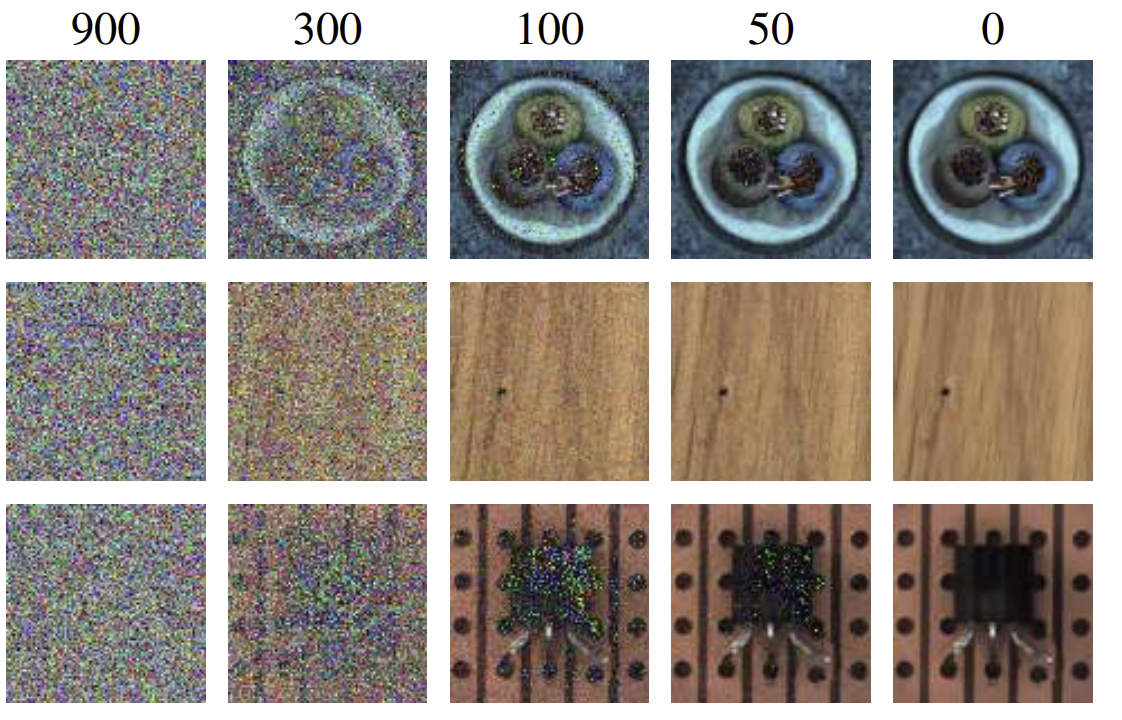
Distributed anomaly detection with attention-guided diffusion models and client-side defect generation

A distributed industrial anomaly-detection framework designed for privacy-constrained production sites, where client-side defect generation and attention-guided diffusion support robust learning without centralizing sensitive data.

🏭

Distributed production lines

🔒

Privacy-aware learning

Client-side defect generation

🧠

Attention-guided diffusion

🧪

Heterogeneous defect data

Distributed diffusion-based anomaly detection

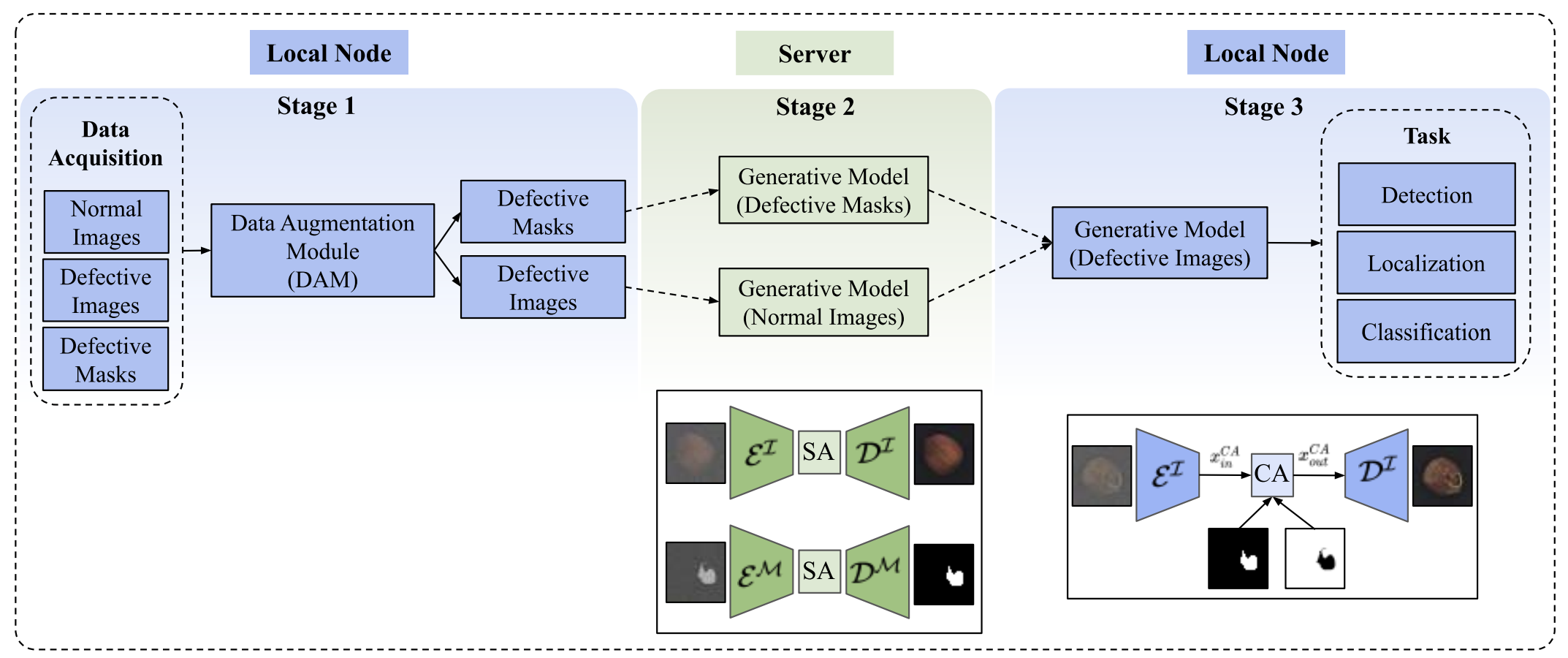
Modern industrial inspection often involves multiple production sites, heterogeneous acquisition pipelines, and privacy constraints that make centralized training impractical. This method addresses that setting by combining distributed anomaly detection with attention-guided diffusion models and local defect synthesis. Each client can enrich scarce anomalous samples by generating defect-like evidence on-site, while the attention mechanism focuses the model on regions that are most informative for distinguishing normal products from defects. The result is a privacy-aware pipeline for learning anomaly detectors across distributed environments without requiring raw manufacturing data to be pooled in a single location.

Distributed anomaly detection with attention-guided diffusion outline

Image and Vision Computing, vol. 163, no. 105741, November, 2025

OneN: Guided attention for natively-explainable anomaly detection

OneN focuses on natively explainable anomaly detection, integrating guided attention into the model so that predictions are accompanied by meaningful localization cues instead of relying only on post-hoc explanations.

🎯

Guided attention

🔎

Native explainability

🧭

Anomaly localization

🧩

Joint decision pipeline

📊

Industrial inspection

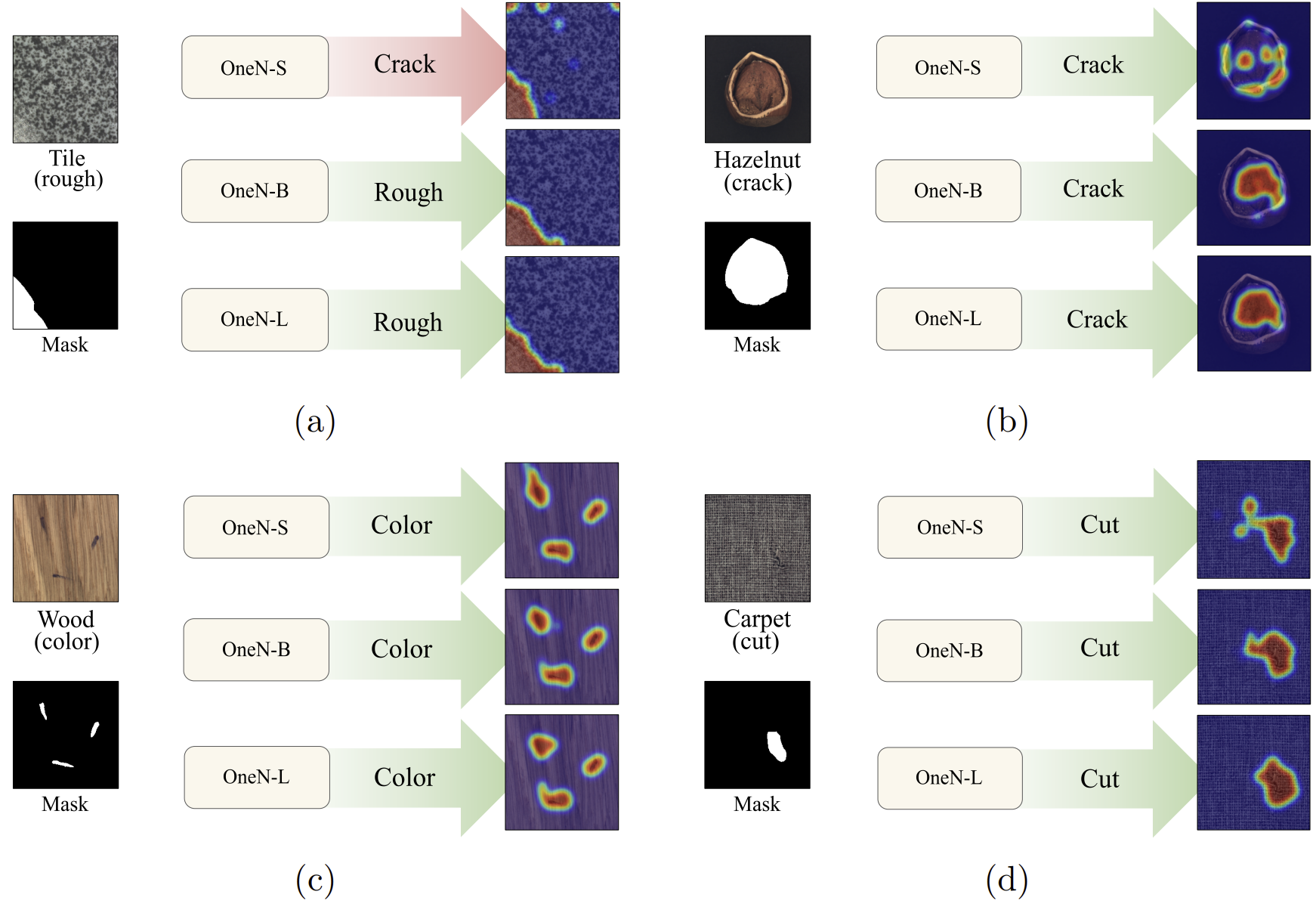
OneN guided attention anomaly detection outline

Guided attention for explainable anomaly detection

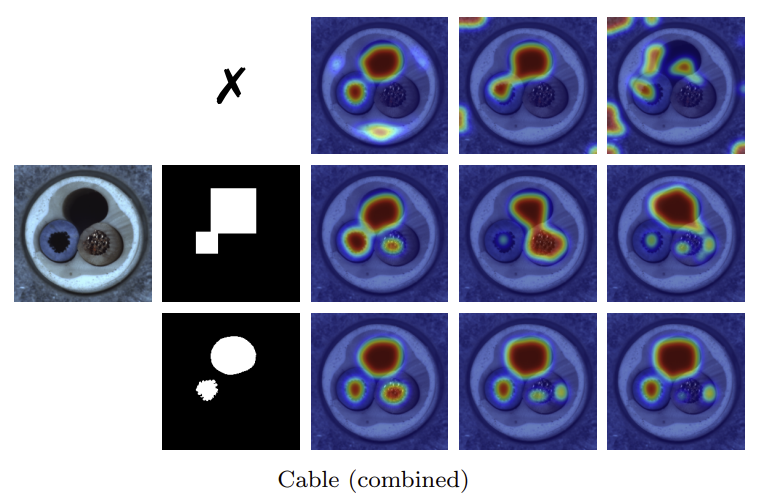
Many anomaly-detection systems separate the final defect decision from the explanation or localization stage. OneN is presented as a natively explainable approach: guided attention is embedded directly in the anomaly-detection pipeline so the model can highlight relevant regions while performing the decision task. This supports industrial visual inspection scenarios where a system should not only flag an item as anomalous, but also provide interpretable evidence that helps operators understand where the defect is and why the sample deviates from normality.

Proc. of the 2023 IEEE Int. Conf. on Image Processing (ICIP 2023), Kuala Lumpur, Malaysia, October 8-11, 2023

Adversarial defect synthesis for industrial products in low data regime

A generative approach for low-data industrial inspection, synthesizing realistic defective samples from defect-free products and producing localization masks to improve downstream anomaly-detection models.

⚙️

Industrial products

📉

Low-data regime

🔁

Image-to-image translation

🩹

Synthetic defects

🗺️

Defect masks

Adversarial synthesis of scarce industrial defects

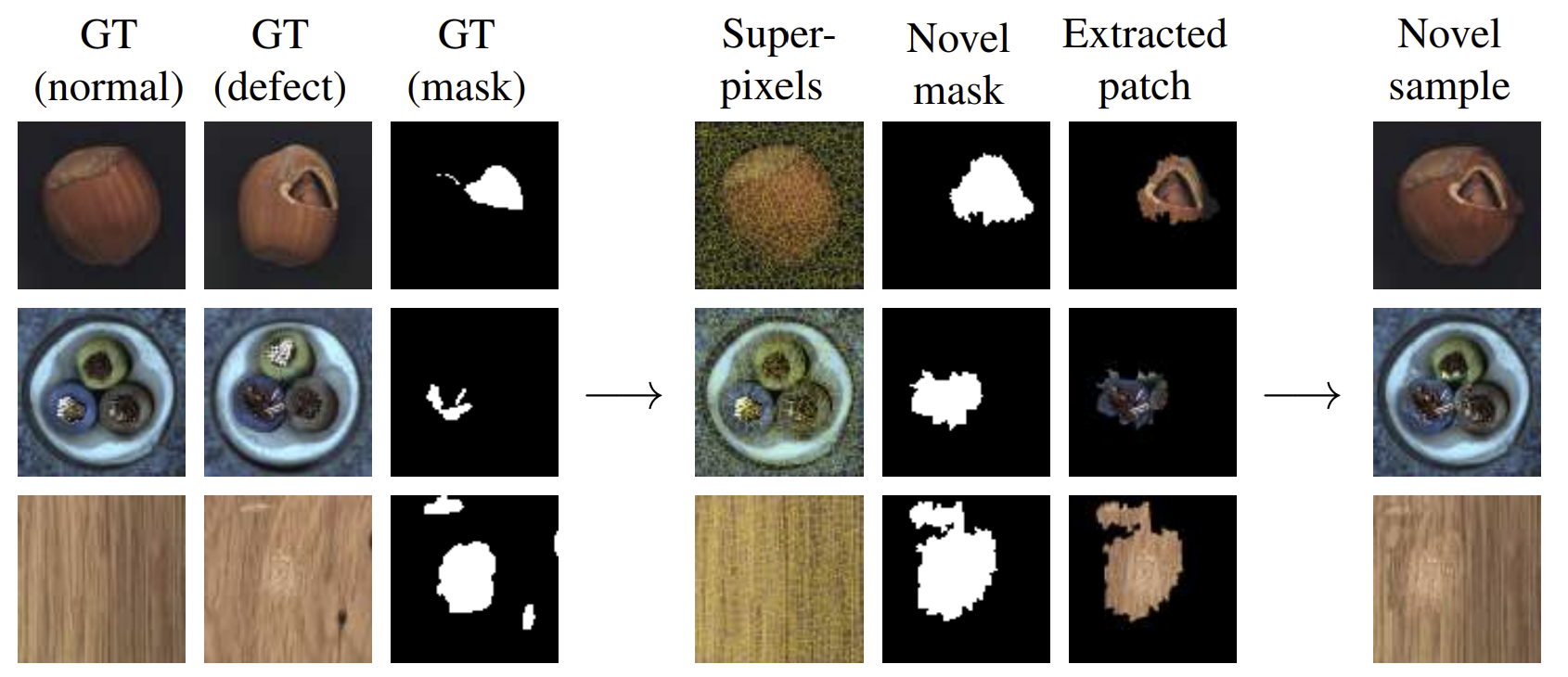
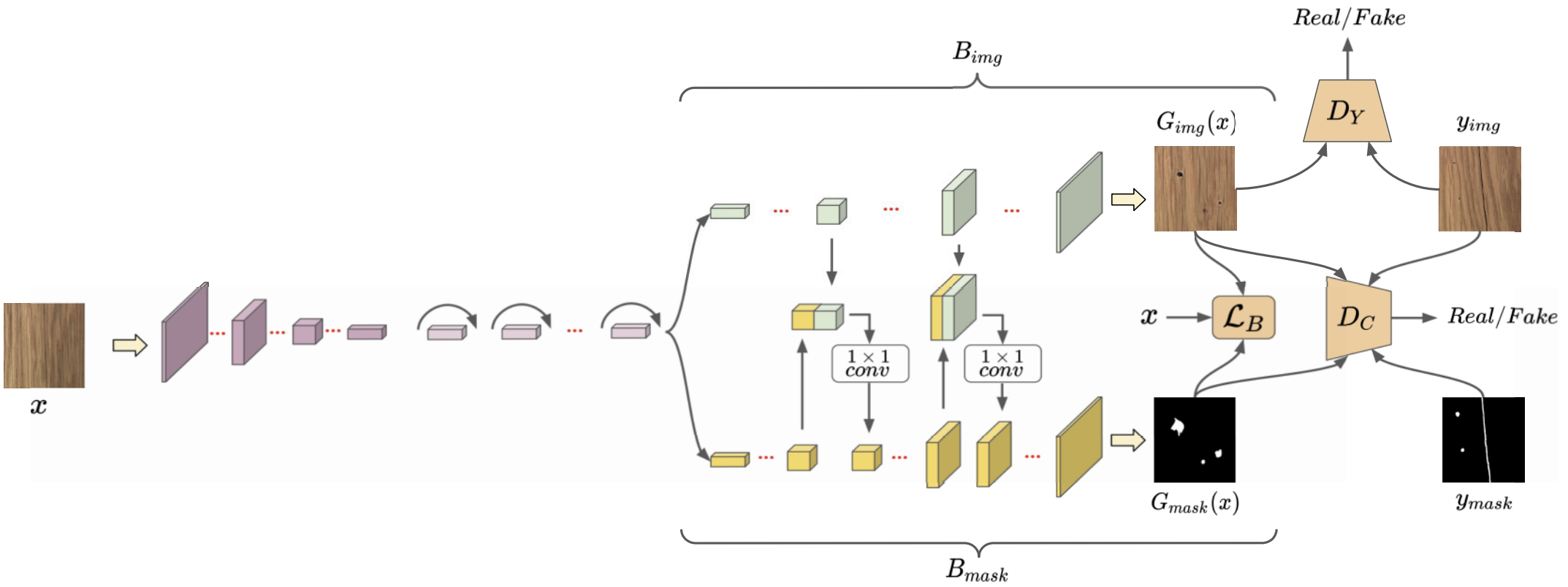
Industrial anomaly detection is frequently limited by the small number of available defective samples: real faults can be rare, costly to collect, or restricted by operational and privacy constraints. This method tackles the low-data regime with an adversarial image-to-image translation architecture that transforms defect-free products into plausible defective samples. At the same time, it estimates segmentation masks for the synthesized defects, enabling both data augmentation and localization. The generated samples can then be used to train or strengthen inspection networks, improving their ability to identify real defective products.

Adversarial defect synthesis method outline

Publications

Distributed anomaly detection with attention-guided diffusion models and client-side defect generation

P. Coscia, A. Genovese, V. Piuri, K. N. Plataniotis, and F. Scotti, "Distributed anomaly detection with attention-guided diffusion models and client-side defect generation", in IEEE Systems Journal, vol. 19, no. 4, December, 2025, pp. 1145-1156. ISSN: 1937-9234.

OneN: Guided attention for natively-explainable anomaly detection

P. Coscia, A. Genovese, V. Piuri, and F. Scotti, "OneN: Guided attention for natively-explainable anomaly detection", in Image and Vision Computing, vol. 163, no. 105741, November, 2025, pp. 1-18. ISSN: 0262-8856.

Adversarial defect synthesis for industrial products in low data regime

P. Coscia, A. Genovese, F. Scotti, and V. Piuri, "Adversarial defect synthesis for industrial products in low data regime", in Proc. of the 2023 IEEE Int. Conf. on Image Processing (ICIP 2023), Kuala Lumpur, Malaysia, October 8-11, 2023, pp. 1360-1364. ISBN: 978-1-7281-9835-4.

Cite this work

@Article{jsyst25,
    author = {P. Coscia and A. Genovese and V. Piuri and K. N. Plataniotis and F. Scotti},
    title = {Distributed anomaly detection with attention-guided diffusion models and client-side defect generation},
    journal = {IEEE Systems Journal},
    volume = {19},
    number = {4},
    pages = {1145-1156},
    month = {December},
    year = {2025},
    doi = {10.1109/JSYST.2025.3619401},
    note = {ISSN: 1937-9234}
}
@Article{imavis25_onen,
    author = {P. Coscia and A. Genovese and V. Piuri and F. Scotti},
    title = {OneN: Guided attention for natively-explainable anomaly detection},
    journal = {Image and Vision Computing},
    volume = {163},
    number = {105741},
    pages = {1-18},
    month = {November},
    year = {2025},
    doi = {10.1016/j.imavis.2025.105741},
    note = {ISSN: 0262-8856}
}
@InProceedings{icip23_ads,
    author = {P. Coscia and A. Genovese and F. Scotti and V. Piuri},
    title = {Adversarial defect synthesis for industrial products in low data regime},
    booktitle = {Proc. of the 2023 IEEE Int. Conf. on Image Processing (ICIP 2023)},
    address = {Kuala Lumpur, Malaysia},
    pages = {1360-1364},
    month = {October},
    day = {8-11},
    year = {2023},
    doi = {10.1109/ICIP49359.2023.10222874},
    note = {ISBN: 978-1-7281-9835-4}
}

Acknowledgements

We gratefully acknowledge the support of NVIDIA Corporation with the donation of the Titan X Pascal GPU used for this research, within the project "Deep Learning and CUDA for advanced and less-constrained biometric systems".

People and institutions

Pasquale Coscia

Proposer and maintainer

Department of Computer Science, Università degli Studi di Milano

pasquale.coscia AT unimi.it

Angelo Genovese

Proposer and maintainer

Department of Computer Science, Università degli Studi di Milano

angelo.genovese AT unimi.it

Vincenzo Piuri

Co-author

Department of Computer Science, Università degli Studi di Milano

vincenzo.piuri AT unimi.it

Konstantinos N. Plataniotis

Co-author

Department of Electrical and Computer Engineering, University of Toronto

kostas AT ece.utoronto.ca

Fabio Scotti

Co-author

Department of Computer Science, Università degli Studi di Milano

fabio.scotti AT unimi.it