Hematopathology · Deep Learning · Medical Imaging

DL4ALL

Deep learning for accurate and explainable Acute Lymphoblastic Leukemia detection.

Accurate and explainable Acute Lymphoblastic Leukemia detection based on Deep Learning, CNN, ViT, and statistical analysis.

Computer Aided Diagnosis (CAD) are increasingly based on Deep Learning: CNNs and ViTs have the ability of automatically learning data representations, without the need for a handcrafted feature extraction step, with the consequence that CAD systems may be designed with limited knowledge of the application scenario.

DL4ALL
Interleaved training
ALL-IDB Patches
Patch-based representation
DSS and XAI ALL
Decision support system for explainable ALL detection

Acute Lymphoblastic (or Lymphocytic) Leukemia (ALL) is a disease that affects the blood cells, can spread rapidly throughout the body, and may result in fatal consequences if not detected at an early stage. One of the techniques routinely used to diagnose ALL consists in analyzing White Blood Cells (WBC) present in peripheral blood samples to look for malformations or abnormalities. Such malformations may be an indicator of lymphoblasts, which naturally occur in the bone marrow. However, an elevated number of WBCs with lymphoblast characteristics may be a sign of ALL.

Traditionally, the analysis of the WBC morphology is performed manually by an expert pathologist, who looks at the blood cells and estimates the concentration of lymphoblasts present in peripheral blood. Such process, being extremely repetitive and time-consuming, may lead to fatigue, with the consequence that the pathologist could miss important information correlated with the presence of ALL.

To overcome the disadvantages of a manual inspection process, Computer Aided Diagnosis (CAD) systems are being increasingly researched: such systems are often based on image processing and machine learning and, by automatically detecting lymphoblasts, can help the pathologist in performing a preliminary screening of the blood samples. Among CAD systems, recent methods are increasingly considering the use of machine learning approaches based on Deep Learning (DL) and Convolutional Neural Networks (CNN), due to their high accuracy in several fields, including medical imaging. In particular, CNNs have the ability of automatically learning data representations, without the need for a handcrafted feature extraction step, with the consequence that CAD systems based on CNNs may be designed with limited knowledge of the application scenario.
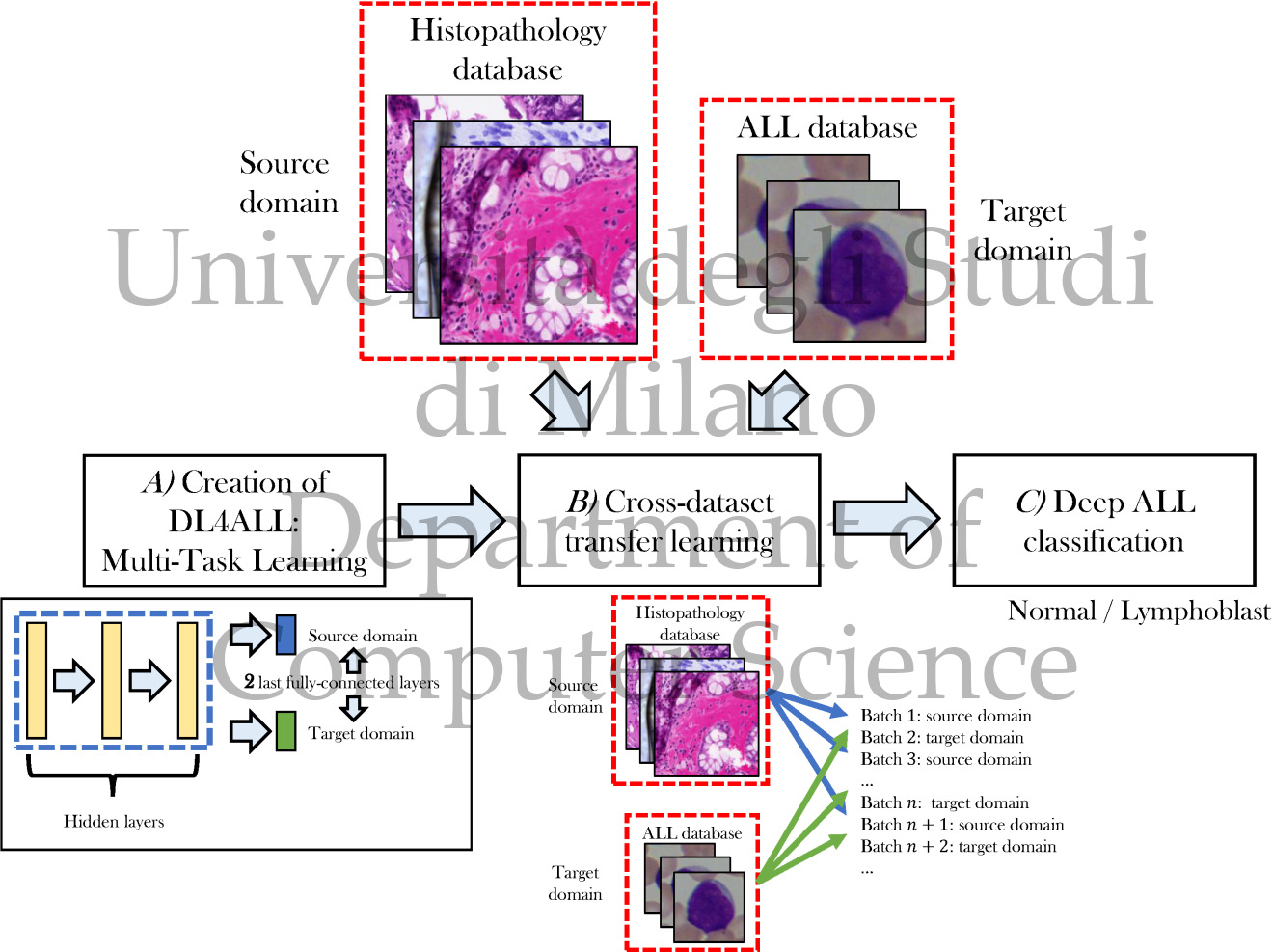
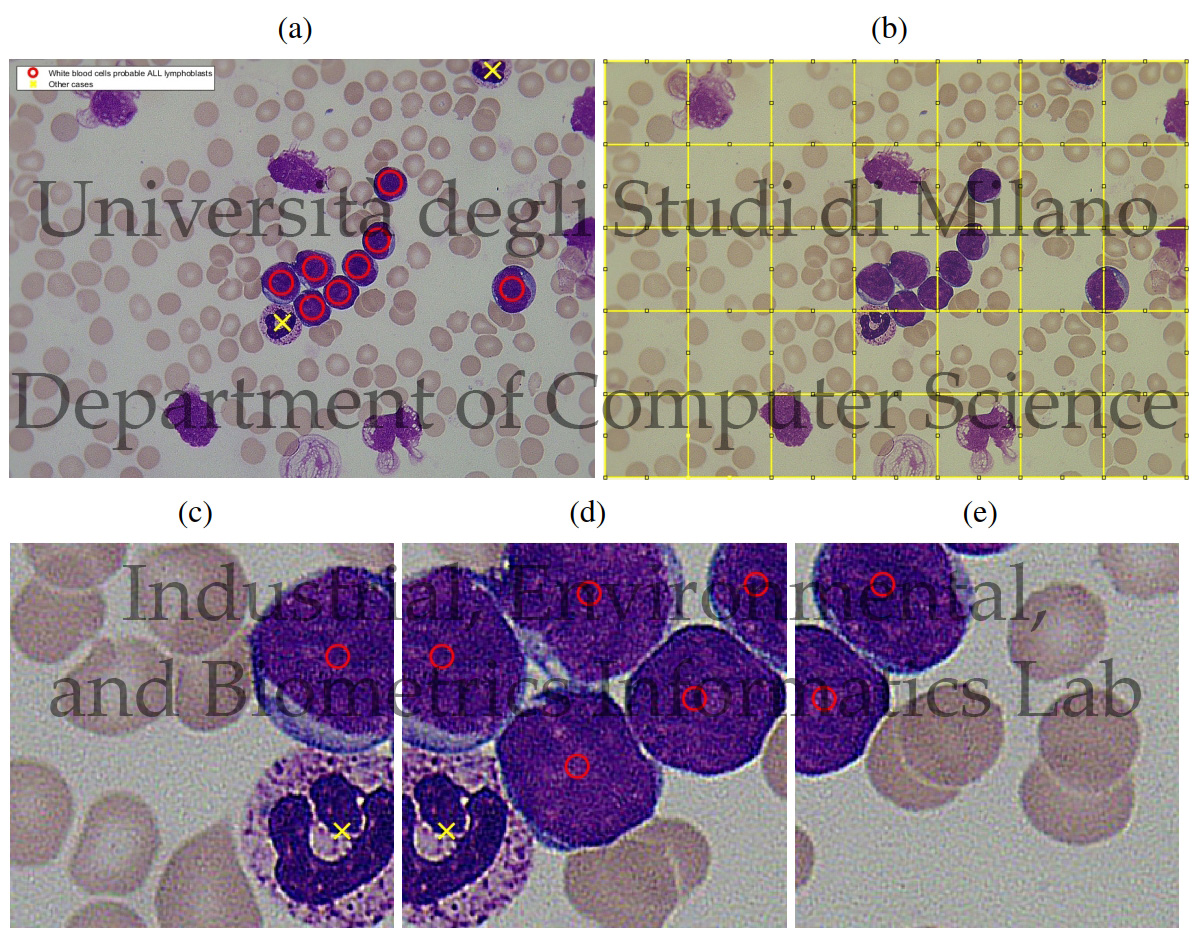
Image and Vision Computing, vol. 151, no. 105298, November, 2024

A decision support system for Acute Lymphoblastic Leukemia Detection based on Explainable Artificial Intelligence

Causality introduced with a metric learning approach and XAI techniques to support the decision

🔬

Histopathological pretraining

💉

Class injection

📐

Metric learning

💡

Explainable classification

🧭

Decision support

Explainable AI for ALL detection

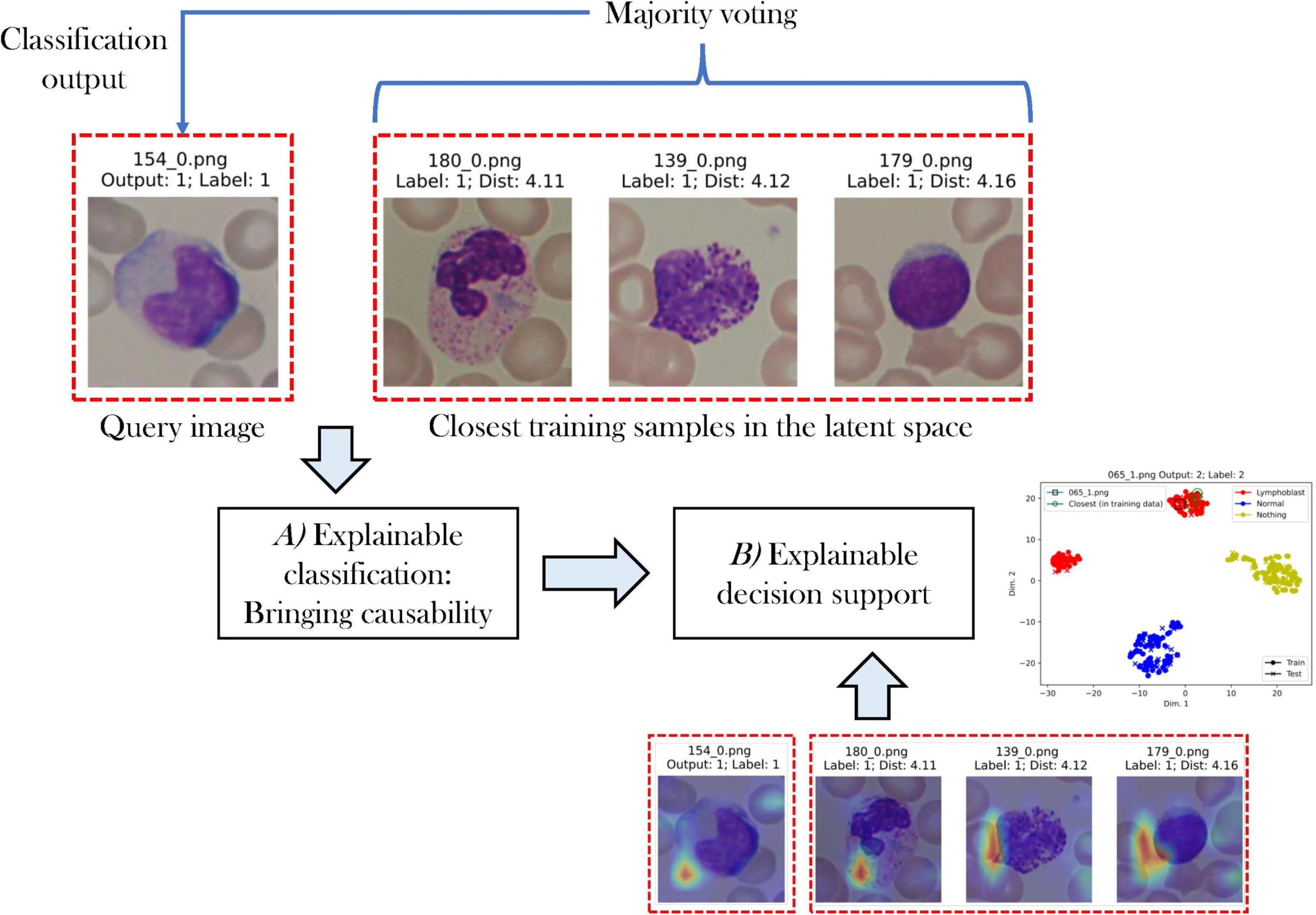
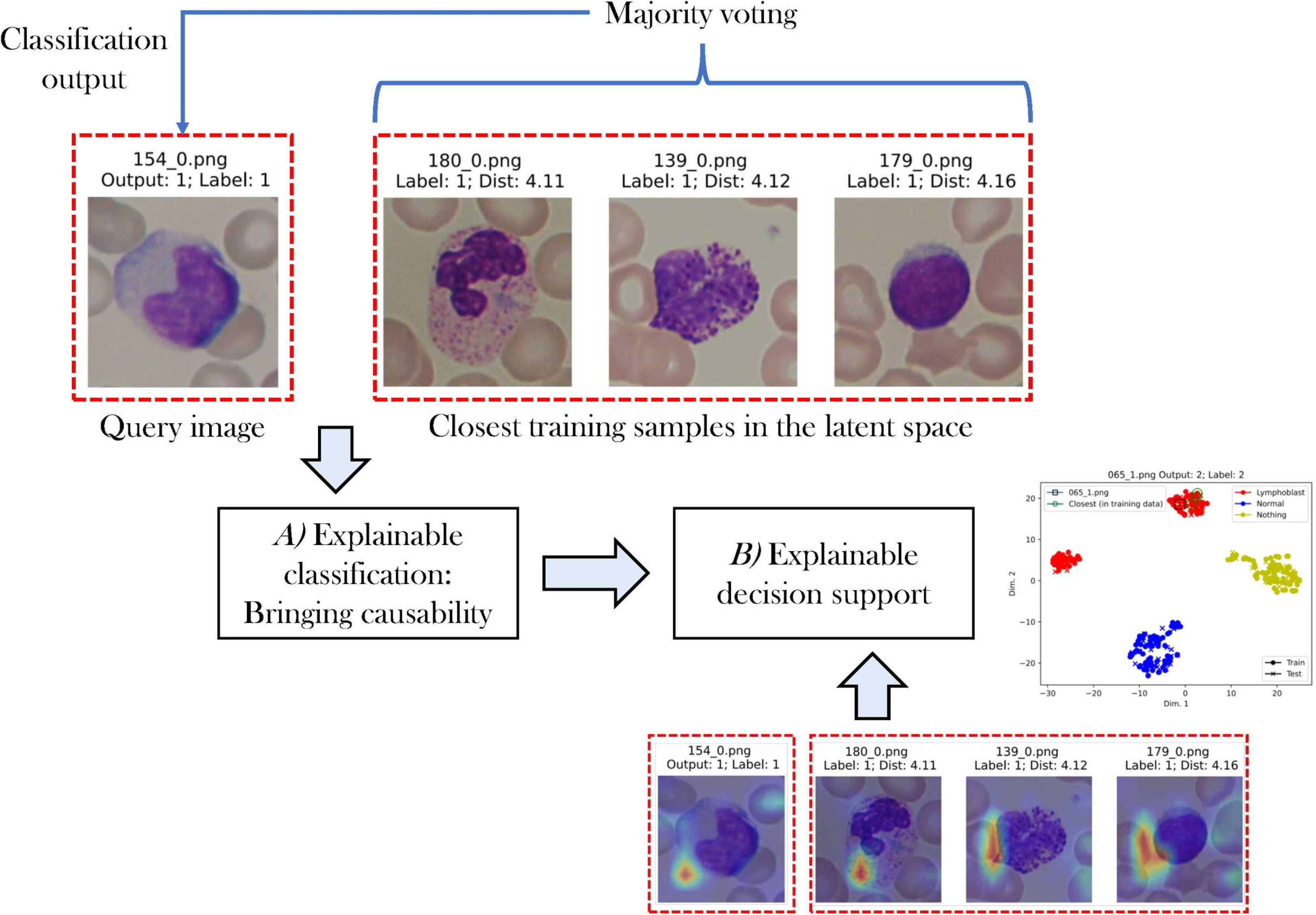
We propose an innovative decision support system for ALL detection that is based on DL and explainable artificial intelligence (XAI). Our approach first introduces causality into the decision with a metric learning approach, enabling a decision to be made by analyzing the most similar images in the database. Second, our method integrates XAI techniques to allow even non-trained personnel to obtain an informed decision by analyzing which regions of the images are most similar and how the samples are organized in the latent space.

DSS XAI method outline 1
DSS XAI method outline 2

IEEE Access, vol. 11, 2023

DL4ALL: Multi-task cross-dataset transfer learning for Acute Lymphoblastic Leukemia detection

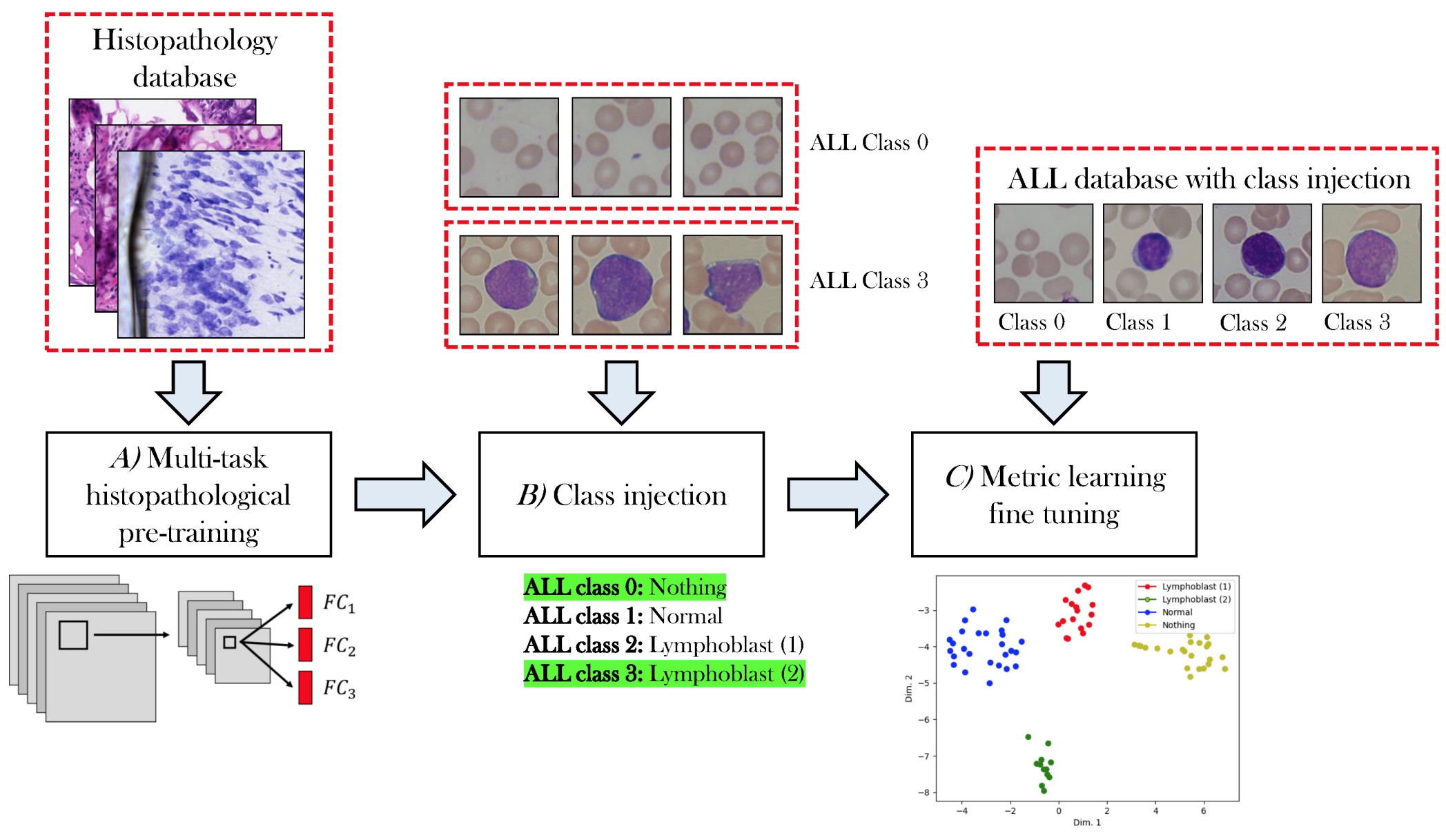
DL4ALL is a multi-task learning DL model for ALL detection, trained using a cross-dataset transfer learning approach

🧩

Multi-task learning

🔁

Cross-dataset transfer learning

🩸

Deep ALL classification

ALLNet method outline

Cross-dataset interleaved training for ALL

We propose "Deep Learning for Acute Lymphoblastic Leukemia" (DL4ALL), a novel multi-task learning DL model for ALL detection, trained using a cross-dataset transfer learning approach. The method adapts an existing model into a multi-task classification problem, then trains it using transfer learning procedures that consider both source and target databases at the same time, interleaving batches from the two domains even when they are significantly different.

IEEE Int. Conf. on Acoustics Speech and Signal Processing Workshops (ICASSPW 2023)

ALL-IDB Patches: Whole slide imaging for Acute Lymphoblastic Leukemia detection using Deep Learning

ALL-IDB Patches leverages all information contained in the ALL-IDB1 dataset

Patch-based processing of ALL whole slide images

We propose the ALL-IDB Patches approach, which consists in cropping portions of the WSIs contained in the ALL-IDB1 dataset, with the purpose of making the WSIs usable for DL-based algorithms and exploiting all the information contained in WSIs.

HistoTnet method outline

2022 IEEE Int. Conf. on Computational Intelligence and Virtual Environments for Measurement Systems and Applications (CIVEMSA 2022)

ALLNet: Acute Lymphoblastic Leukemia Detection Using Lightweight Convolutional Networks

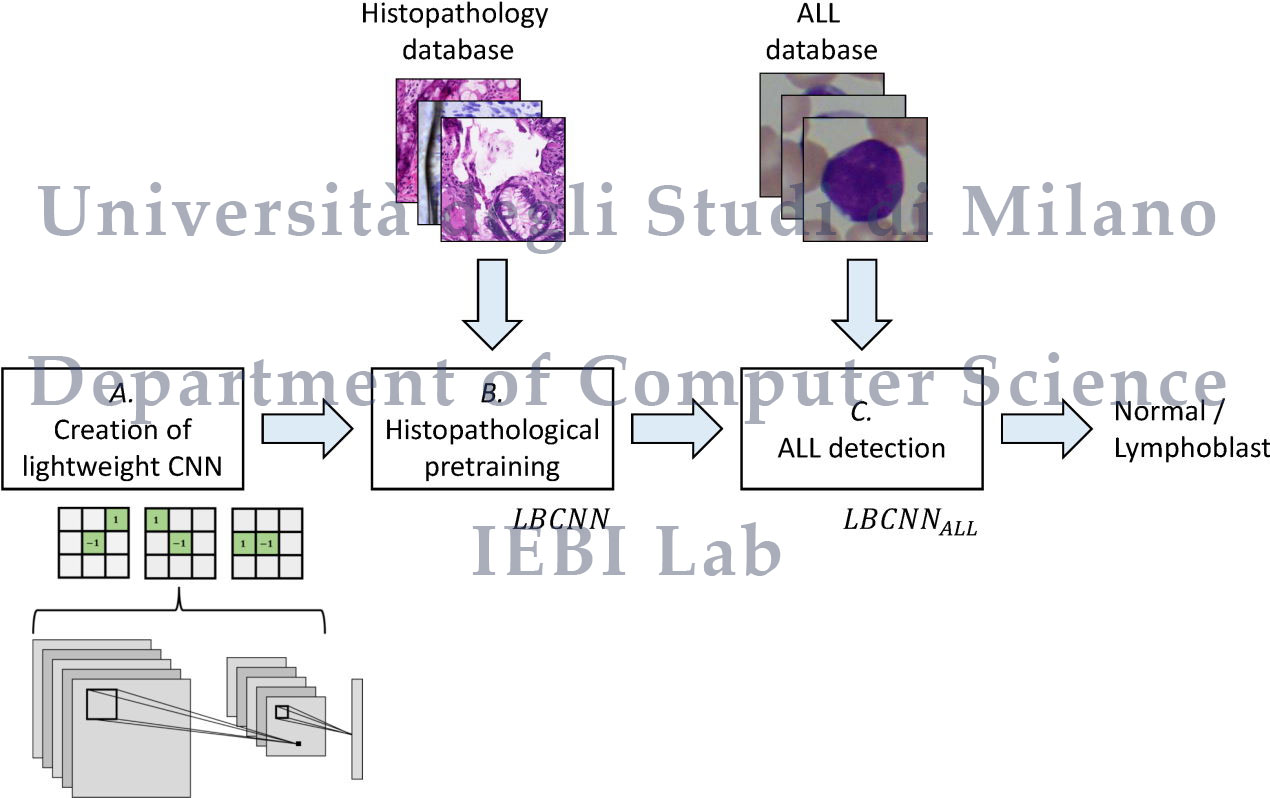
ALLNet uses a lightweight architecture based on fixed binary kernels that replicate the Local Binary Patterns

🧠

Creation of ALLNet

🔬

Histopathological pretraining

🎯

ALL detection

ALLNet method outline

Lightweight CNNs for ALL

We propose ALLNet, the first approach in the literature for ALL detection using a lightweight architecture based on fixed binary kernels that replicate the Local Binary Patterns and that uses only ≈1.6% of the parameters of a traditional CNN, at the same time achieving better results in terms of classification accuracy.

2021 IEEE Int. Conf. on Computational Intelligence and Virtual Environments for Measurement Systems and Applications (CIVEMSA 2021)

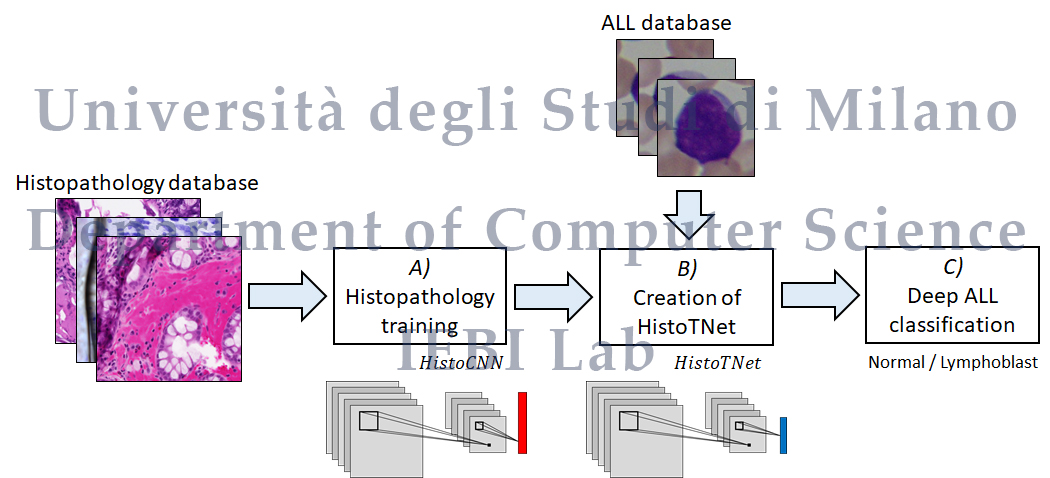
Histopathological transfer learning for Acute Lymphoblastic Leukemia detection

HistoTNet is trained on histopathology database, then tuned on the ALL database to detect the presence of lymphoblasts

🧫

Histopathology training

🔁

Creation of HistoTNet

🩸

Deep ALL classification

Histopathological transfer learning

We propose the first method based on histopathological transfer learning for ALL detection, which trains a CNN on a histopathology database to classify tissue types, then performs a fine tuning on the ALL database to detect the presence of lymphoblasts. As histopathology database, we consider a multi-label dataset with a significantly higher number of samples and classes with respect to the literature, which enables CNNs to learn general features for histopathology image processing and hence allow to perform a more effective transfer learning, with respect to CNNs pretrained on ImageNet. We evaluate the methodology on a publicly-available ALL database and considering multiple CNNs, with results confirming the validity of our approach.

HistoTnet method outline

2021 IEEE Int. Conf. on Acoustics, Speech, and Signal Processing (ICASSP 2021)

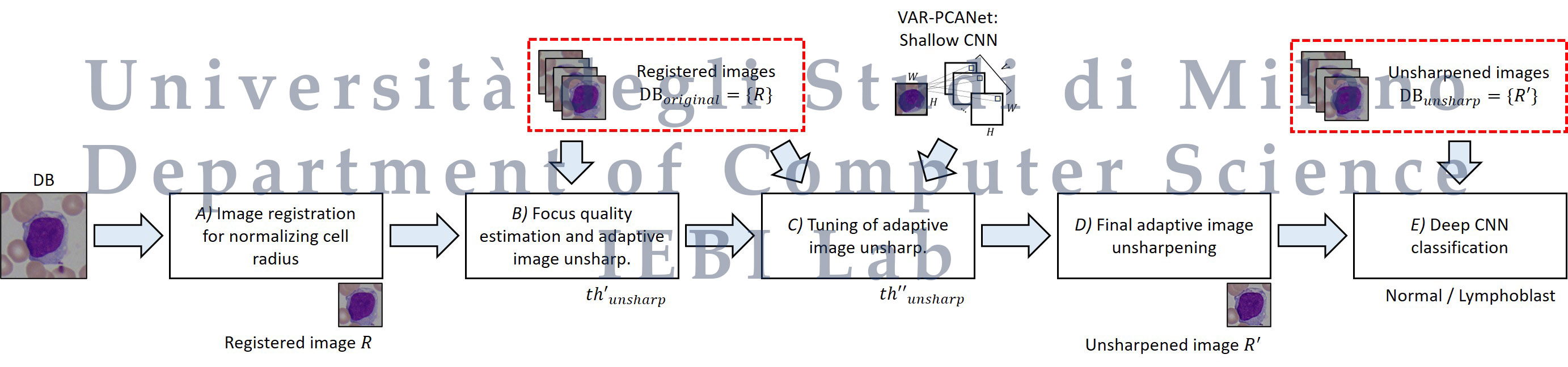
Acute Lymphoblastic Leukemia detection based on adaptive unsharpening and Deep Learning

Enhancing blood sample images by an adaptive unsharpening method

🧩

Image registration

🔎

Focus estimation

Adaptive unsharpening

⚙️

Tuning

🎯

Classification

Unsharp method outline

Adaptive unsharpening for ALL

We propose the first machine learning-based approach able to enhance blood sample images by an adaptive unsharpening method. The method uses image processing techniques and DL to normalize the radius of the cell, estimate the focus quality, adaptively improve the sharpness of the images, and then perform the classification. We evaluated the methodology on a public database of ALL images, considering several state-of-the-art CNNs to perform the classification, with results showing the validity of the proposed approach.

Publications

A Decision Support System for Acute Lymphoblastic Leukemia Detection based on Explainable Artificial Intelligence

A. Genovese, V. Piuri, and F. Scotti, "A Decision Support System for Acute Lymphoblastic Leukemia Detection based on Explainable Artificial Intelligence", in Image and Vision Computing, vol. 151, no. 105298, November, 2024. ISSN: 0262-8856.

DL4ALL: Multi-task cross-dataset transfer learning for Acute Lymphoblastic Leukemia detection

A. Genovese, V. Piuri, K. N. Plataniotis, and F. Scotti, "DL4ALL: Multi-task cross-dataset transfer learning for Acute Lymphoblastic Leukemia detection", in IEEE Access, vol. 11, 2023, pp. 65222-65237. ISSN: 2169-3536.

ALL-IDB Patches: Whole slide imaging for Acute Lymphoblastic Leukemia detection using Deep Learning

A. Genovese, V. Piuri, and F. Scotti, "ALL-IDB Patches: Whole slide imaging for Acute Lymphoblastic Leukemia detection using Deep Learning", in Proc. of the IEEE Int. Conf. on Acoustics Speech and Signal Processing Workshops (ICASSPW 2023), Rhodes Island, Greece, June 4-10, 2023, pp. 1-5. ISBN: 979-8-3503-0261-5.

ALLNet: Acute Lymphoblastic Leukemia detection using lightweight convolutional networks

A. Genovese, "ALLNet: Acute Lymphoblastic Leukemia detection using lightweight convolutional networks", in Proc. of the 2022 IEEE Int. Conf. on Computational Intelligence and Virtual Environments for Measurement Systems and Applications (CIVEMSA 2022), Chemnitz, Germany, June 15-17, 2022, pp. 1-6. ISBN: 978-1-6654-3445-4.

Histopathological transfer learning for Acute Lymphoblastic Leukemia detection

A. Genovese, M. S. Hosseini, V. Piuri, K. N. Plataniotis, and F. Scotti, "Histopathological transfer learning for Acute Lymphoblastic Leukemia detection", in Proc. of the 2021 IEEE Int. Conf. on Computational Intelligence and Virtual Environments for Measurement Systems and Applications (CIVEMSA 2021), June 18-20, 2021, pp. 1-6. ISBN: 978-1-6654-1249-0.

Acute Lymphoblastic Leukemia detection based on adaptive unsharpening and Deep Learning

A. Genovese, M. S. Hosseini, V. Piuri, K. N. Plataniotis, and F. Scotti, "Acute Lymphoblastic Leukemia detection based on adaptive unsharpening and Deep Learning", in Proc. of the 2021 IEEE Int. Conf. on Acoustics, Speech, and Signal Processing (ICASSP 2021), Toronto, ON, Canada, June 6-11, 2021, pp. 1205-1209. ISBN: 978-1-7281-7605-5.

Cite this work

@Article {imavis24,
    author = {A. Genovese and V. Piuri and F. Scotti},
    title = {A Decision Support System for Acute Lymphoblastic Leukemia Detection based on Explainable Artificial Intelligence},
    journal = {Image and Vision Computing},
    volume = {151},
    number = {105298},
    month = {November},
    year = {2024},
    note = {0262-8856}
}
@Article {access23,
    author = {A. Genovese and V. Piuri and K. N. Plataniotis and F. Scotti},
    title = {DL4ALL: Multi-task cross-dataset transfer learning for Acute Lymphoblastic Leukemia detection},
    journal = {IEEE Access},
    volume = {11},
    pages = {65222-65237},
    year = {2023},
    note = {2169-3536}
}
@InProceedings {aimia23,
    author = {A. Genovese and V. Piuri and F. Scotti},
    booktitle = {Proc. of the IEEE Int. Conf. on Acoustics Speech and Signal Processing Workshops
    (ICASSPW 2023)},
    title = {ALL-IDB Patches: Whole slide imaging for Acute Lymphoblastic Leukemia detection using
    Deep Learning},
    address = {Rhodes Island, Greece},
    pages = {1-5},
    month = {June},
    day = {4-10},
    year = {2023},
    note = {979-8-3503-0261-5}
}
@InProceedings {civemsa22_all,
    author = {A. Genovese},
    booktitle = {Proc. of the 2022 IEEE Int. Conf. on Computational Intelligence and Virtual Environments for
    Measurement Systems and Applications (CIVEMSA 2022)},
    title = {ALLNet: Acute Lymphoblastic Leukemia detection using lightweight convolutional networks},
    address = {Chemnitz, Germany},
    pages = {1-6},
    month = {June},
    day = {15-17},
    year = {2022},
    note = {978-1-6654-3445-4}
}
@InProceedings {civemsa21all,
    author = {A. Genovese and M. S. Hosseini and V. Piuri and K. N. Plataniotis and F. Scotti},
    booktitle = {Proc. of the 2021 IEEE Int. Conf. on Computational Intelligence and Virtual Environments for
    Measurement Systems and Applications (CIVEMSA 2021)},
    title = {Histopathological transfer learning for Acute Lymphoblastic Leukemia detection},
    pages = {1-6},
    month = {June},
    day = {18-20},
    year = {2021},
    note = {978-1-6654-1249-0},
}
@InProceedings {icassp21,
    author = {A. Genovese and M. S. Hosseini and V. Piuri and K. N. Plataniotis and F. Scotti},
    booktitle = {Proc. of the 2021 IEEE Int. Conf. on Acoustics, Speech, and Signal Processing (ICASSP 2021)},
    title = {Acute Lymphoblastic Leukemia detection based on adaptive unsharpening and Deep Learning},
    address = {Toronto, ON, Canada},
    pages = {1205-1209},
    month = {June},
    day = {6-11},
    year = {2021},
    note = {978-1-7281-7605-5},
}

Acknowledgements

We gratefully acknowledge the support of NVIDIA Corporation with the donation of the Titan X Pascal GPU used for this research, within the project "Deep Learning and CUDA for advanced and less-constrained biometric systems".

People and institutions

Angelo Genovese

Proposer and maintainer

Department of Computer Science, Università degli Studi di Milano

angelo.genovese AT unimi.it

Mahdi S. Hosseini

Co-author

Department of Electrical and Computer Engineering, University of New Brunswick

Vincenzo Piuri

Co-author

Department of Computer Science, Università degli Studi di Milano

vincenzo.piuri AT unimi.it

Konstantinos N. Plataniotis

Co-author

Department of Electrical and Computer Engineering, University of Toronto

kostas AT ece.utoronto.ca

Fabio Scotti

Co-author

Department of Computer Science, Università degli Studi di Milano

fabio.scotti AT unimi.it