
V. Piuri, F. Scotti, Design of an automatic wood types classification system by using fluorescence spectra, IEEE Transactions on Systems, Man, and Cybernetics, Part C: Applications and Reviews, vol. 40, no. 3, pp. 358-366, May 2010, ISSN 1094-6977.
Industrial informatics
Wood Classification
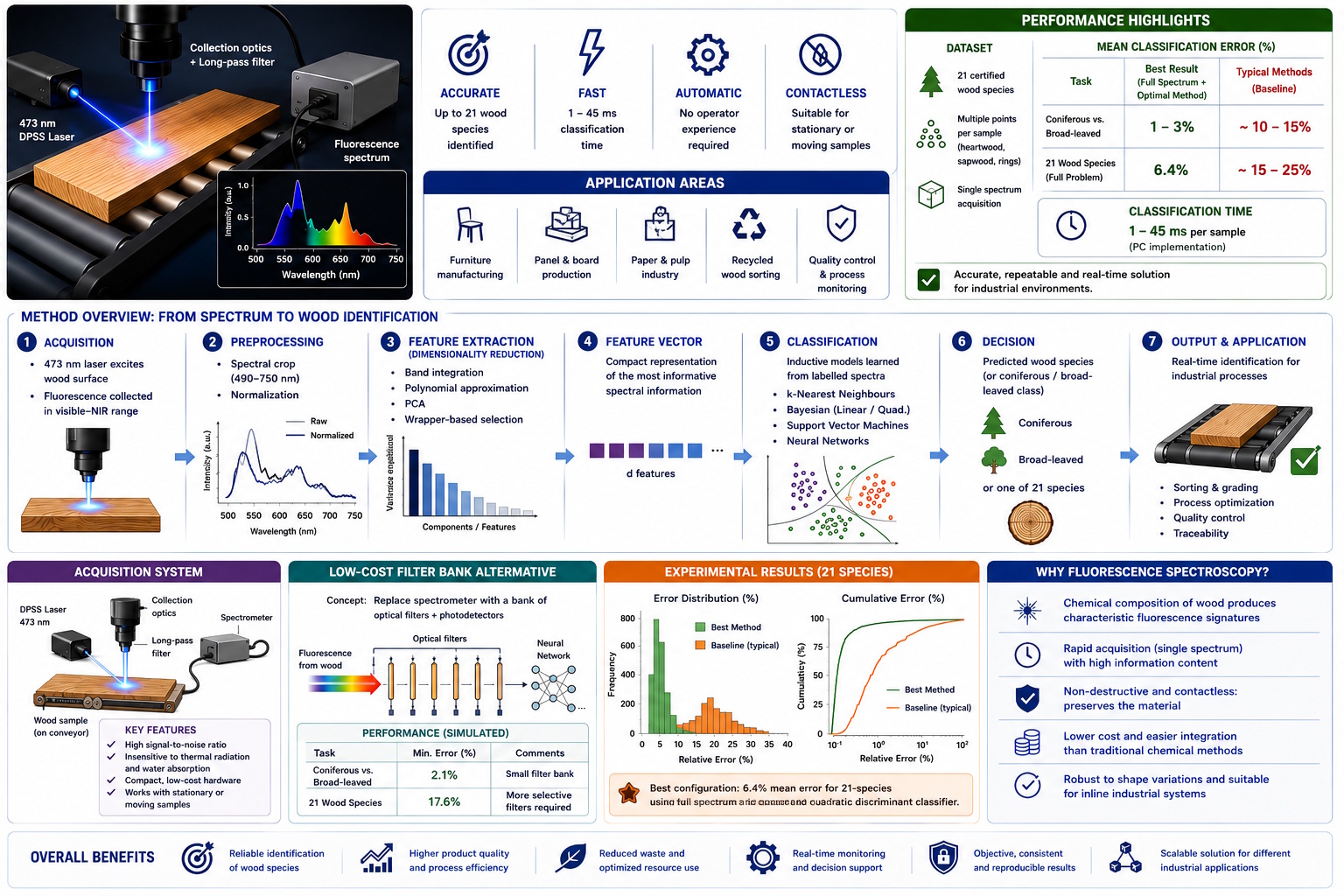
The Wood Classification project investigates automatic methods for identifying wood species in furniture manufacturing, panel production, paper processing, and other industrial sectors. Correct wood identification is important because different species have different appearance, cost, mechanical behaviour, cellulose content, and processing requirements. In panel production, for example, wood type can influence the amount of adhesive needed to obtain the required mechanical properties, affecting both production cost and environmental impact.
Conventional classification is commonly performed by experienced operators through visual inspection of wood slices and surfaces. This procedure is slow and its accuracy depends strongly on operator expertise, attention, and fatigue. Chemical and conventional spectroscopic analyses are available, but they are generally more expensive, time-consuming, and difficult to apply continuously to moving material on an industrial line.
The project therefore explores fluorescence spectroscopy as a contactless alternative suitable for rapid inline measurements. A diode-pumped solid-state laser operating at 473 nm excites the wood surface, and the emitted fluorescence is measured in the visible and near-infrared region. The approach offers high signal-to-noise ratio, limited sensitivity to thermal radiation and water absorption, and the possibility of using relatively inexpensive silicon detectors and compact optical components.
The prototype acquisition system consists of a laser source, collection optics, an optical long-pass filter, and a miniature spectrometer. The filter suppresses the excitation laser line, allowing the fluorescence spectrum to be measured more effectively. The system can analyse stationary or moving samples and does not impose strict constraints on the shape of the material, making it applicable to boards, slices, particles, and recycled wood streams.
After acquisition, the spectrum is cropped to the most informative wavelength region, approximately 490–750 nm, and normalized to compensate for variations in absorption, surface position, and signal intensity. Different preprocessing strategies are studied to enhance the separation among wood classes before classification.
Because the complete spectrum contains hundreds of samples, the project investigates several dimensionality-reduction methods. These include integration of the spectral energy into equally spaced wavelength bands, polynomial approximation, principal-component analysis, and wrapper-based feature selection. The aim is to retain the most discriminative information while reducing computational and hardware requirements.
Multiple inductive classifiers are evaluated, including k-nearest-neighbour models, linear and quadratic Bayesian classifiers, support vector machines, and neural networks. The classification rules are learned directly from labelled fluorescence measurements because the relationship between spectral shape and wood species cannot be described reliably through simple analytical thresholds.
The experimental dataset contains 21 certified wood types, with spectra acquired from multiple points of each sample, including heartwood, sapwood, and growth-ring regions. The research considers both a binary problem—distinguishing coniferous from broad-leaved woods—and the more demanding task of identifying the individual wood species.
For coniferous versus broad-leaved classification, the best configurations obtained errors around 1–3%, depending on feature representation and classifier. For the complete 21-species problem, quadratic discriminant classification reached a mean error of 6.4% using a single spectrum acquisition. Classification times ranged from approximately 1 to 45 ms on the reported hardware, supporting the feasibility of real-time industrial operation.
The project also investigates a lower-cost embedded alternative that replaces the spectrometer with a bank of optical filters and photodetectors. Each filter integrates a portion of the fluorescence spectrum, producing a compact input vector for a feed-forward neural network. This configuration reduces hardware complexity and can be implemented in a dedicated circuit or integrated into existing industrial equipment.
Simulations based on real wood spectra showed that a small filter bank could distinguish coniferous and broad-leaved woods with a minimum error of 2.1%. Identifying all 21 wood types required a more selective filter configuration and produced a minimum error of 17.6%, highlighting the trade-off between hardware cost, spectral resolution, and classification accuracy.
Overall, the project provides a complete methodology for automatic wood identification, covering optical acquisition, spectral preprocessing, feature extraction, classifier design, and low-cost embedded implementation. Its main contribution is a rapid, repeatable, and contactless alternative to manual inspection and laboratory testing, suitable for continuous monitoring of heterogeneous wood materials in industrial production.
Conventional classification is commonly performed by experienced operators through visual inspection of wood slices and surfaces. This procedure is slow and its accuracy depends strongly on operator expertise, attention, and fatigue. Chemical and conventional spectroscopic analyses are available, but they are generally more expensive, time-consuming, and difficult to apply continuously to moving material on an industrial line.
The project therefore explores fluorescence spectroscopy as a contactless alternative suitable for rapid inline measurements. A diode-pumped solid-state laser operating at 473 nm excites the wood surface, and the emitted fluorescence is measured in the visible and near-infrared region. The approach offers high signal-to-noise ratio, limited sensitivity to thermal radiation and water absorption, and the possibility of using relatively inexpensive silicon detectors and compact optical components.
The prototype acquisition system consists of a laser source, collection optics, an optical long-pass filter, and a miniature spectrometer. The filter suppresses the excitation laser line, allowing the fluorescence spectrum to be measured more effectively. The system can analyse stationary or moving samples and does not impose strict constraints on the shape of the material, making it applicable to boards, slices, particles, and recycled wood streams.
After acquisition, the spectrum is cropped to the most informative wavelength region, approximately 490–750 nm, and normalized to compensate for variations in absorption, surface position, and signal intensity. Different preprocessing strategies are studied to enhance the separation among wood classes before classification.
Because the complete spectrum contains hundreds of samples, the project investigates several dimensionality-reduction methods. These include integration of the spectral energy into equally spaced wavelength bands, polynomial approximation, principal-component analysis, and wrapper-based feature selection. The aim is to retain the most discriminative information while reducing computational and hardware requirements.
Multiple inductive classifiers are evaluated, including k-nearest-neighbour models, linear and quadratic Bayesian classifiers, support vector machines, and neural networks. The classification rules are learned directly from labelled fluorescence measurements because the relationship between spectral shape and wood species cannot be described reliably through simple analytical thresholds.
The experimental dataset contains 21 certified wood types, with spectra acquired from multiple points of each sample, including heartwood, sapwood, and growth-ring regions. The research considers both a binary problem—distinguishing coniferous from broad-leaved woods—and the more demanding task of identifying the individual wood species.
For coniferous versus broad-leaved classification, the best configurations obtained errors around 1–3%, depending on feature representation and classifier. For the complete 21-species problem, quadratic discriminant classification reached a mean error of 6.4% using a single spectrum acquisition. Classification times ranged from approximately 1 to 45 ms on the reported hardware, supporting the feasibility of real-time industrial operation.
The project also investigates a lower-cost embedded alternative that replaces the spectrometer with a bank of optical filters and photodetectors. Each filter integrates a portion of the fluorescence spectrum, producing a compact input vector for a feed-forward neural network. This configuration reduces hardware complexity and can be implemented in a dedicated circuit or integrated into existing industrial equipment.
Simulations based on real wood spectra showed that a small filter bank could distinguish coniferous and broad-leaved woods with a minimum error of 2.1%. Identifying all 21 wood types required a more selective filter configuration and produced a minimum error of 17.6%, highlighting the trade-off between hardware cost, spectral resolution, and classification accuracy.
Overall, the project provides a complete methodology for automatic wood identification, covering optical acquisition, spectral preprocessing, feature extraction, classifier design, and low-cost embedded implementation. Its main contribution is a rapid, repeatable, and contactless alternative to manual inspection and laboratory testing, suitable for continuous monitoring of heterogeneous wood materials in industrial production.
Relevant publications
R. Donida Labati, V. Piuri, F. Scotti, A low-cost neural-based approach for wood types classification, Proc. of the 2009 IEEE Int. Conf. on Computational Intelligence for Measurement Systems and Applications (CIMSA 2009), pp. 199-203, Hong Kong, China, May 2009, ISSN 978-1-4244-3819-8.
P. Camorani, M. Badiali, D. Francomacaro, M. Gamassi, V. Piuri, F. Scotti, M. Zanasi, A classification method for wood types using fluorescence spectra, Proc. of the IEEE Instrumentation and Measurement Technology Conf. (IMTC 2008), pp. 1312-1315, Minneapolis, MN, USA, May 2008, ISSN 1091-5281.