
P. Coscia, A. Genovese, V. Piuri, F. Scotti, Granulo-10k: A large-scale benchmark dataset for multiple-view industrial granulometry, Proc. of the 2026 IEEE Int. Conf. on Image Processing (ICIP 2026), pp. 1-6, Tampere, Finland, September 2026, ISSN 979-8-3315-5151-3.
Industrial informatics
Granulometry
Granulometry describes the size and frequency distribution of particles in a material. It is important in sectors such as pharmaceutical and food production, paper and coating manufacturing, basic-material processing, wood-panel production, and geological analysis, because the dimensions and shapes of particles can directly influence product quality and process behaviour. Conventional granulometric assessment often relies on mechanical sieving or manual inspection of production samples, which is time-consuming, delayed, and potentially unrepresentative of the current state of the process.
The project investigates computer-vision and computational-intelligence techniques for performing automatic, contactless, and potentially inline granulometric analysis. An early research direction introduced a segmentation-free method based on scale-space and wavelet-derived image features. Neural classifiers estimate the probability that each image pixel belongs to a given particle-size class, allowing the overall particle-size distribution to be recovered even when particles touch or overlap. This approach avoids many difficulties associated with explicit segmentation and does not require special particle positioning or foreground/background illumination. On synthetic datasets, the estimated distributions showed errors in the order of small fractions of a percent.
A complementary activity addressed the difficulty of creating accurately labelled datasets for granulometry. Manually locating and measuring every particle in a crowded image is impractical, especially when large numbers of objects are present. The project therefore developed a Blender-based virtual environment capable of simulating the deposition and interaction of many particles, configuring virtual cameras and illumination, and generating photorealistic or controlled synthetic images. Since the complete three-dimensional position and dimensions of every simulated particle are known, the environment provides exact reference data for training, tuning, and comparing image-based granulometric systems. It can also reproduce different acquisition configurations, including stereoscopic and stroboscopic imaging.
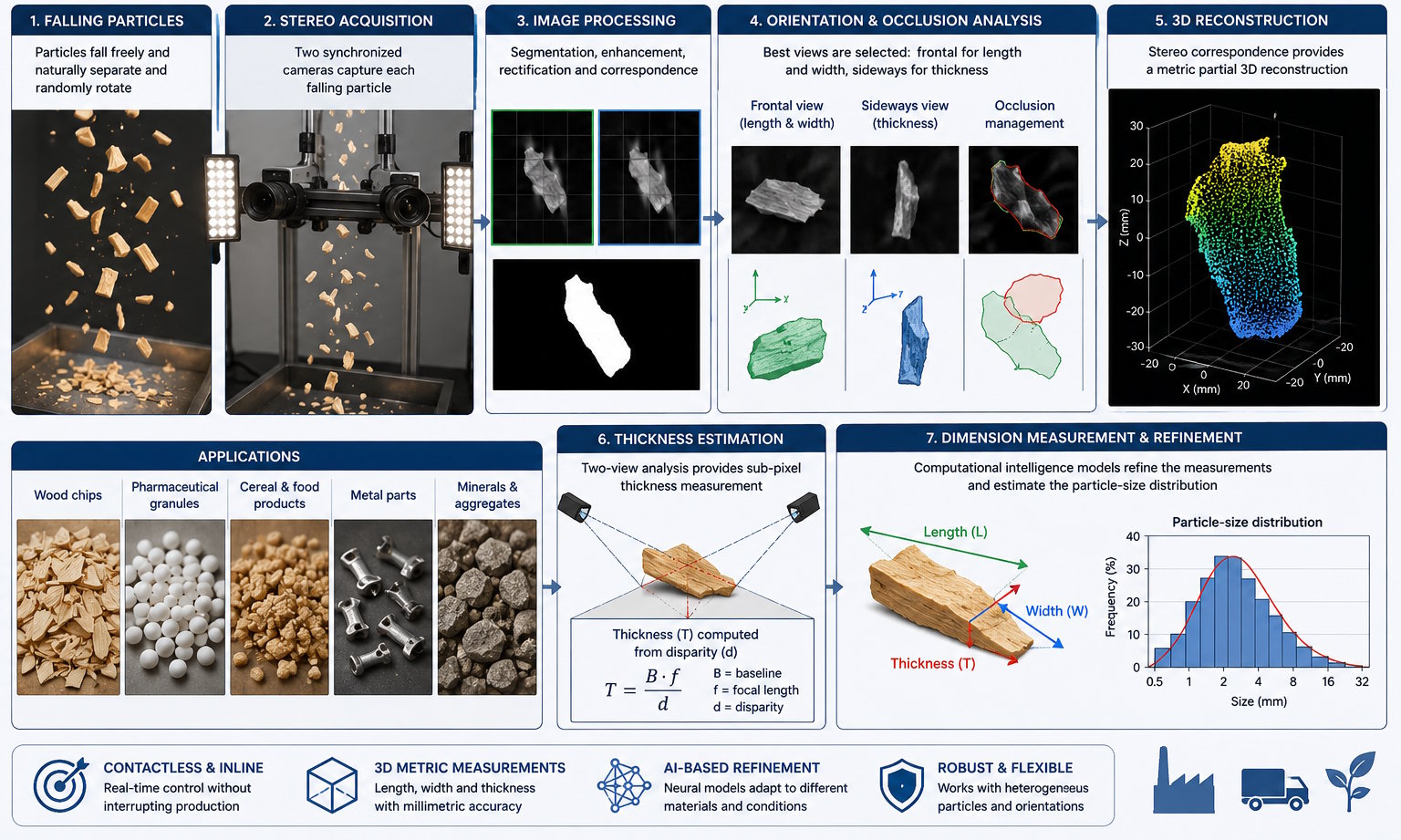
The main evolution of the project concerns the three-dimensional analysis of falling particles. Traditional systems generally inspect particles lying on conveyor belts, where occlusions are frequent, smaller elements may remain hidden below larger ones, and particle thickness is difficult or impossible to measure. The proposed approach instead captures particles while they are falling, exploiting their natural separation and random rotation to observe different orientations and recover all three principal dimensions.
The acquisition system uses two synchronized calibrated cameras, commercial LED illuminators, and a photocell trigger. After segmentation, enhancement, rectification, and occlusion management, the method estimates particle orientation and selects frontal views for length and width measurement and sideways views for thickness measurement. Stereo correspondences provide a metric partial 3D reconstruction, while dedicated two-view processing enables sub-pixel thickness estimation. Neural computational-intelligence models subsequently refine the preliminary measurements and adapt the system to different materials and production conditions.
The complete system was validated on calibration objects, raw wood strands, and manufactured metal plates, using thousands of two-view acquisitions collected under conditions designed to reproduce inline industrial operation. For raw materials, the reported mean errors were approximately 0.98 mm for length, 0.80 mm for width, and 0.10 mm for thickness. For manufactured components, the corresponding errors were approximately 0.40 mm, 0.11 mm, and 0.07 mm. The occlusion-management module distinguished separated and overlapping particles with an accuracy of 96.31%.
Across the investigated cases, the final system achieved errors of at most about 1 mm for length and width and 0.1 mm for thickness. Computational-intelligence refinement consistently reduced measurement errors and increased the correlation between estimated and real particle dimensions. The approach was also shown to be robust to moderate parameter variations and capable of analysing particles with uncontrolled positions and orientations, provided that they remained within the common camera field of view.
Overall, the project provides a progression from segmentation-free neural granulometry and synthetic-data generation to real-time stereo-based 3D inspection of falling particles. Its main contribution is an affordable and adaptable framework for continuous particle-size monitoring that can reduce reliance on offline sampling, improve responsiveness in quality control, and support heterogeneous materials and industrial applications.
The project investigates computer-vision and computational-intelligence techniques for performing automatic, contactless, and potentially inline granulometric analysis. An early research direction introduced a segmentation-free method based on scale-space and wavelet-derived image features. Neural classifiers estimate the probability that each image pixel belongs to a given particle-size class, allowing the overall particle-size distribution to be recovered even when particles touch or overlap. This approach avoids many difficulties associated with explicit segmentation and does not require special particle positioning or foreground/background illumination. On synthetic datasets, the estimated distributions showed errors in the order of small fractions of a percent.
A complementary activity addressed the difficulty of creating accurately labelled datasets for granulometry. Manually locating and measuring every particle in a crowded image is impractical, especially when large numbers of objects are present. The project therefore developed a Blender-based virtual environment capable of simulating the deposition and interaction of many particles, configuring virtual cameras and illumination, and generating photorealistic or controlled synthetic images. Since the complete three-dimensional position and dimensions of every simulated particle are known, the environment provides exact reference data for training, tuning, and comparing image-based granulometric systems. It can also reproduce different acquisition configurations, including stereoscopic and stroboscopic imaging.
The main evolution of the project concerns the three-dimensional analysis of falling particles. Traditional systems generally inspect particles lying on conveyor belts, where occlusions are frequent, smaller elements may remain hidden below larger ones, and particle thickness is difficult or impossible to measure. The proposed approach instead captures particles while they are falling, exploiting their natural separation and random rotation to observe different orientations and recover all three principal dimensions.
The acquisition system uses two synchronized calibrated cameras, commercial LED illuminators, and a photocell trigger. After segmentation, enhancement, rectification, and occlusion management, the method estimates particle orientation and selects frontal views for length and width measurement and sideways views for thickness measurement. Stereo correspondences provide a metric partial 3D reconstruction, while dedicated two-view processing enables sub-pixel thickness estimation. Neural computational-intelligence models subsequently refine the preliminary measurements and adapt the system to different materials and production conditions.
The complete system was validated on calibration objects, raw wood strands, and manufactured metal plates, using thousands of two-view acquisitions collected under conditions designed to reproduce inline industrial operation. For raw materials, the reported mean errors were approximately 0.98 mm for length, 0.80 mm for width, and 0.10 mm for thickness. For manufactured components, the corresponding errors were approximately 0.40 mm, 0.11 mm, and 0.07 mm. The occlusion-management module distinguished separated and overlapping particles with an accuracy of 96.31%.
Across the investigated cases, the final system achieved errors of at most about 1 mm for length and width and 0.1 mm for thickness. Computational-intelligence refinement consistently reduced measurement errors and increased the correlation between estimated and real particle dimensions. The approach was also shown to be robust to moderate parameter variations and capable of analysing particles with uncontrolled positions and orientations, provided that they remained within the common camera field of view.
Overall, the project provides a progression from segmentation-free neural granulometry and synthetic-data generation to real-time stereo-based 3D inspection of falling particles. Its main contribution is an affordable and adaptable framework for continuous particle-size monitoring that can reduce reliance on offline sampling, improve responsiveness in quality control, and support heterogeneous materials and industrial applications.
Relevant publications
R. Donida Labati, A. Genovese, E. Muñoz, V. Piuri, F. Scotti, 3-D granulometry using image processing, IEEE Transactions on Industrial Informatics, vol. 15, no. 3, pp. 1251-1264, March 2019, ISSN 1551-3203.
S. Ferrari, V. Piuri, F. Scotti, Image processing for granulometry analysis via neural networks, Proc. of the 2008 IEEE Int. Conf. on Computational Intelligence for Measurement Systems and Applications (CIMSA 2008), pp. 28-32, Istanbul, Turkey, July 2008, ISSN 978-1-4244-2305-7.
S. Ferrari, V. Piuri, F. Scotti, Virtual environment for granulometry analysis, Proc. of the 2008 IEEE Conf. on Virtual Environments, Human-Computer Interfaces and Measurement Systems (VECIMS 2008), pp. 156-161, Istanbul, Turkey, July 2008, ISSN 978-1-4244-1927-2.