
A. Anand, R. Donida Labati, A. Genovese, E. Muñoz, V. Piuri, F. Scotti, G. Sforza, Enhancing fingerprint biometrics in Automated Border Control with adaptive cohorts, Proc. of the 2016 IEEE Symp. on Computational Intelligence for Security and Defense Applications (CISDA 2016), pp. 1-8, Athens, Greece, December 2016, ISSN 978-1-5090-4240-1.
Biometric systems
ABC Gates for Europe
ABC4EU
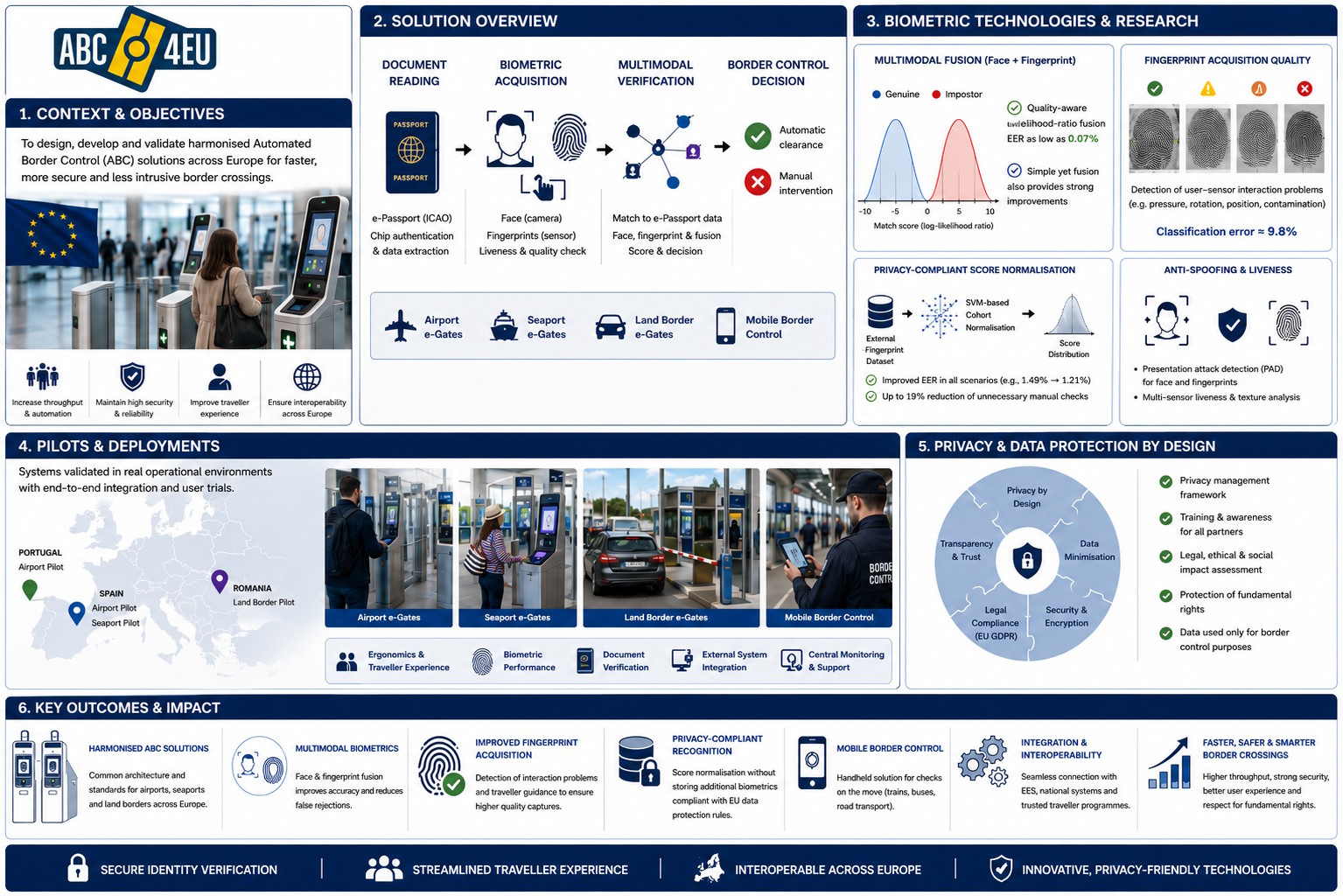
The ABC4EU – ABC Gates for Europe project was a European FP7 initiative carried out from January 2014 to March 2018 to improve the workflow, functionality, interoperability, and user experience of Automated Border Control systems. Coordinated by Indra Sistemas, the project brought together industrial partners, universities, technology providers, and border authorities from several European countries.
Automated Border Control gates verify a traveller’s identity by comparing biometric information stored in an electronic passport or identity document with live samples acquired during the border-crossing procedure. Their purpose is to increase passenger throughput and process automation while preserving the security and reliability of identity checks.
Before ABC4EU, many European deployments differed in gate architecture, traveller interaction, document handling, biometric technologies, signalling, certificate exchange, and connection with national border-management systems. The project therefore pursued a common and harmonised approach suitable for airports, seaports, and land borders.
A principal objective was to exploit second-generation e-passports more effectively by combining the facial and fingerprint information stored in the document. The project studied multimodal biometric verification both for conventional e-Gates and mobile border-control systems, balancing recognition security, traveller convenience, and clearance time.
The research showed that combining face and fingerprint scores can improve recognition compared with relying on the most accurate individual modality alone. In the evaluated scenarios, quality-aware likelihood-ratio fusion achieved equal-error rates as low as 0.07%, while simpler sum-based fusion also provided substantial improvements and remained suitable for technology-neutral implementations using algorithms from different vendors.
Another major activity addressed the non-ideal fingerprint acquisitions typical of operational border controls. Travellers may interact incorrectly with the sensor because of stress, limited experience, luggage, finger contamination, pressure, or positioning errors. These factors can reduce image quality and increase false rejections even when the underlying recognition technology is accurate.
The project developed computational-intelligence techniques for automatically identifying the type of user–sensor interaction responsible for degraded fingerprint images. The proposed classifier obtained an error of approximately 9.8%, demonstrating the feasibility of recognising acquisition problems and potentially giving travellers targeted feedback for repeating the capture correctly.
A further contribution concerned privacy-compliant score normalisation. Conventional cohort-based methods often require additional biometric templates or access to operational traveller data, which is problematic under European data-protection rules. The proposed approach instead used an external fingerprint dataset and machine-learning models to normalise matching scores without storing additional traveller biometrics.
Support-vector-machine-based cohort normalisation improved a commercial fingerprint matcher in all evaluated scenarios. Depending on the dataset, the equal-error rate was reduced from 1.49% to 1.21%, from 3.97% to 3.34%, and from 3.59% to approximately 3.40%. Under a privacy-compliant evaluation procedure inspired by Frontex, the method also reduced the false-non-match burden and was estimated to decrease unnecessary manual identity checks by up to 19%.
The project also studied the complete biometric architecture of an e-Gate, including acquisition devices, document authentication, matching software, quality assessment, liveness and anti-spoofing measures, performance evaluation, traveller guidance, and interaction with border guards. Particular attention was given to unconstrained and contactless acquisition technologies that could simplify use and reduce delays.
Beyond biometric recognition, ABC4EU developed prototypes for integration with the European Entry/Exit System and a National Facilitation or Registered Traveller programme for frequent, pre-screened third-country nationals. It also designed a handheld mobile solution intended for border checks inside trains, buses, and other situations in which officers must operate while moving.
The developed technologies were evaluated through two pilot phases. Prototype and final systems were tested in Portugal at an airport, in Spain at airport and seaport sites, and in Romania at a land border. The pilots assessed ergonomics, traveller experience, document verification, biometric performance, external-system integration, mobile operation, and central monitoring and support.
Privacy, data protection, legal compliance, ethics, and public acceptance were treated as transversal design requirements rather than as assessments performed only after development. The project established a privacy-management framework, trained technical partners, reviewed the activities of each work package, and evaluated the pilots from legal, social, and ethical perspectives.
Overall, ABC4EU produced a coordinated framework for the next generation of European Automated Border Control. Its results combined harmonised gate design, multimodal biometrics, improved fingerprint acquisition, privacy-compliant recognition, anti-spoofing, document verification, mobile border checks, and integration with European border-management infrastructures. The project demonstrated these technologies under operational conditions while pursuing faster passenger processing, stronger identity assurance, interoperability across countries, and respect for fundamental rights.
Automated Border Control gates verify a traveller’s identity by comparing biometric information stored in an electronic passport or identity document with live samples acquired during the border-crossing procedure. Their purpose is to increase passenger throughput and process automation while preserving the security and reliability of identity checks.
Before ABC4EU, many European deployments differed in gate architecture, traveller interaction, document handling, biometric technologies, signalling, certificate exchange, and connection with national border-management systems. The project therefore pursued a common and harmonised approach suitable for airports, seaports, and land borders.
A principal objective was to exploit second-generation e-passports more effectively by combining the facial and fingerprint information stored in the document. The project studied multimodal biometric verification both for conventional e-Gates and mobile border-control systems, balancing recognition security, traveller convenience, and clearance time.
The research showed that combining face and fingerprint scores can improve recognition compared with relying on the most accurate individual modality alone. In the evaluated scenarios, quality-aware likelihood-ratio fusion achieved equal-error rates as low as 0.07%, while simpler sum-based fusion also provided substantial improvements and remained suitable for technology-neutral implementations using algorithms from different vendors.
Another major activity addressed the non-ideal fingerprint acquisitions typical of operational border controls. Travellers may interact incorrectly with the sensor because of stress, limited experience, luggage, finger contamination, pressure, or positioning errors. These factors can reduce image quality and increase false rejections even when the underlying recognition technology is accurate.
The project developed computational-intelligence techniques for automatically identifying the type of user–sensor interaction responsible for degraded fingerprint images. The proposed classifier obtained an error of approximately 9.8%, demonstrating the feasibility of recognising acquisition problems and potentially giving travellers targeted feedback for repeating the capture correctly.
A further contribution concerned privacy-compliant score normalisation. Conventional cohort-based methods often require additional biometric templates or access to operational traveller data, which is problematic under European data-protection rules. The proposed approach instead used an external fingerprint dataset and machine-learning models to normalise matching scores without storing additional traveller biometrics.
Support-vector-machine-based cohort normalisation improved a commercial fingerprint matcher in all evaluated scenarios. Depending on the dataset, the equal-error rate was reduced from 1.49% to 1.21%, from 3.97% to 3.34%, and from 3.59% to approximately 3.40%. Under a privacy-compliant evaluation procedure inspired by Frontex, the method also reduced the false-non-match burden and was estimated to decrease unnecessary manual identity checks by up to 19%.
The project also studied the complete biometric architecture of an e-Gate, including acquisition devices, document authentication, matching software, quality assessment, liveness and anti-spoofing measures, performance evaluation, traveller guidance, and interaction with border guards. Particular attention was given to unconstrained and contactless acquisition technologies that could simplify use and reduce delays.
Beyond biometric recognition, ABC4EU developed prototypes for integration with the European Entry/Exit System and a National Facilitation or Registered Traveller programme for frequent, pre-screened third-country nationals. It also designed a handheld mobile solution intended for border checks inside trains, buses, and other situations in which officers must operate while moving.
The developed technologies were evaluated through two pilot phases. Prototype and final systems were tested in Portugal at an airport, in Spain at airport and seaport sites, and in Romania at a land border. The pilots assessed ergonomics, traveller experience, document verification, biometric performance, external-system integration, mobile operation, and central monitoring and support.
Privacy, data protection, legal compliance, ethics, and public acceptance were treated as transversal design requirements rather than as assessments performed only after development. The project established a privacy-management framework, trained technical partners, reviewed the activities of each work package, and evaluated the pilots from legal, social, and ethical perspectives.
Overall, ABC4EU produced a coordinated framework for the next generation of European Automated Border Control. Its results combined harmonised gate design, multimodal biometrics, improved fingerprint acquisition, privacy-compliant recognition, anti-spoofing, document verification, mobile border checks, and integration with European border-management infrastructures. The project demonstrated these technologies under operational conditions while pursuing faster passenger processing, stronger identity assurance, interoperability across countries, and respect for fundamental rights.
Relevant publications
R. Donida Labati, A. Genovese, E. Muñoz, V. Piuri, F. Scotti, G. Sforza, Biometric recognition in Automated Border Control: a survey, ACM Computing Surveys, vol. 49, no. 2, pp. 24:1-24:39, November 2016, ISSN 0360-0300.
R. Donida Labati, A. Genovese, E. Muñoz, V. Piuri, F. Scotti, G. Sforza, Emerging biometric technologies for Automated Border Control gates, Proc. of the 13th Int. Conf. on Pattern Recognition and Information Processing (PRIP 2016), Minsk, Belarus, October 2016.
A. Anand, R. Donida Labati, A. Genovese, E. Muñoz, V. Piuri, F. Scotti, G. Sforza, Enhancing the performance of multimodal Automated Border Control systems, Proc. of the 15th Int. Conf. of the Biometrics Special Interest Group (BIOSIG 2016), pp. 1-5, Darmstadt, Germany, September 2016, ISSN 978-3-8857-9654-1.
R. Donida Labati, A. Genovese, E. Muñoz, V. Piuri, F. Scotti, G. Sforza, Automated Border Control systems: biometric challenges and research trends, Proc. of the 11th Int. Conf. on Information Systems Security (ICISS 2015), Lecture Notes in Computer Science, vol. 9478, pp. 11-20, Kolkata, India, December 2015, ISSN 978-3-319-26960-3.
R. Donida Labati, A. Genovese, E. Muñoz, V. Piuri, F. Scotti, G. Sforza, Automatic classification of acquisition problems affecting fingerprint images in Automated Border Controls, Proc. of the 2015 IEEE Symp. on Computational Intelligence in Biometrics and Identity Management (CIBIM 2015), pp. 354-361, Cape Town, South Africa, December 2015, ISSN 978-1-4799-7560-0.
R. Donida Labati, A. Genovese, E. Muñoz, V. Piuri, F. Scotti, G. Sforza, Advanced design of Automated Border Control gates: biometric system techniques and research trends, Proc. of the 2015 IEEE Int. Symp. on Systems Engineering (ISSE 2015), pp. 412-419, Rome, Italy, September 2015, ISSN 978-1-4799-1920-8.