
R. Donida Labati, A. Genovese, V. Piuri, F. Scotti, Toward unconstrained fingerprint recognition: a fully-touchless 3-D system based on two views on the move, IEEE Transactions on Systems, Man, and Cybernetics: Systems, vol. 46, no. 2, pp. 202-219, February 2016, ISSN 2168-2216.
Biometric systems
Touchless 3D Fingerprint Recognition
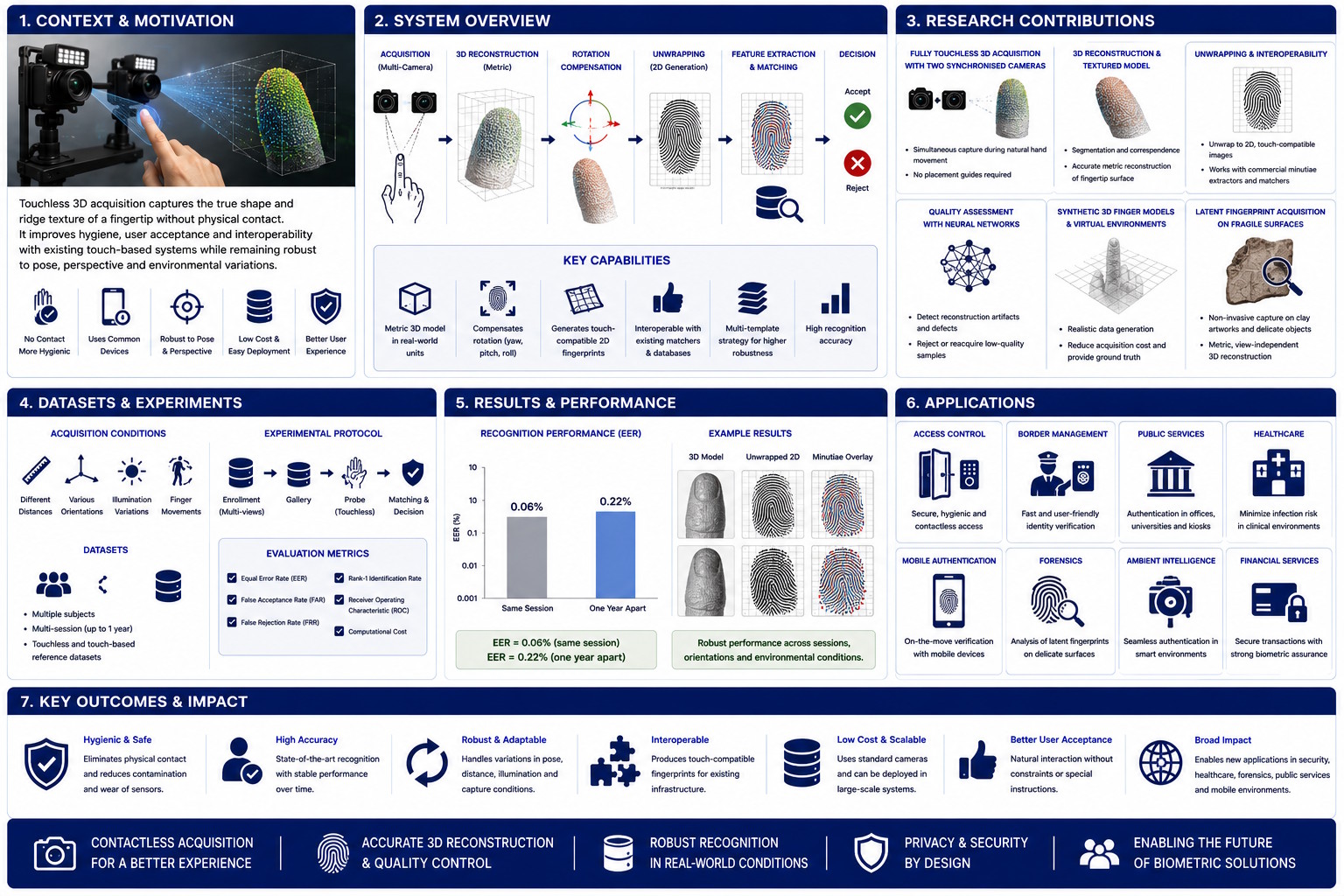
Touchless 3D Fingerprint Recognition is a research activity aimed at overcoming the limitations of conventional fingerprint sensors through completely contactless acquisition. Traditional systems require users to press a fingertip against a platen, potentially causing nonlinear skin deformation, uneven contrast due to pressure or moisture, contamination of the sensor and the release of latent fingerprints. Three-dimensional touchless techniques instead acquire the finger using cameras, reconstruct its metric shape and preserve a larger portion of the ridge pattern without requiring contact with any surface.
A principal outcome of the research is a fully touchless system based on two synchronised cameras. The images are captured simultaneously while the finger moves naturally through the acquisition area, without placement guides. Dedicated algorithms segment the fingertip, identify corresponding points in the two views and reconstruct a textured 3D model whose dimensions are expressed in real-world units. Because the reconstruction is metric, it reduces the scale and perspective variations that commonly affect single-camera touchless systems. The model can also be rotated virtually to compensate for differences in yaw, pitch and roll between successive acquisitions.
The reconstructed surface is subsequently unwrapped to generate one or more two-dimensional, touch-compatible fingerprint images. These representations can be processed by established minutiae extractors and matchers originally designed for contact-based sensors, facilitating compatibility with existing biometric databases and infrastructures. A multi-template strategy generates several views during enrolment and combines their matching scores during verification, increasing robustness to changes in finger orientation and visible ridge area. Experimental evaluation considered recognition accuracy, computational cost, user acceptance, environmental robustness and interoperability with touch-based technologies. The complete system achieved an Equal Error Rate of 0.06% for samples acquired in one session and 0.22% for acquisitions distributed over one year.
The project also introduced neural techniques for assessing the quality of fingerprints obtained by unwrapping 3D models. These methods detect reconstruction artefacts, deformed ridge regions and other defects that could negatively affect matching, allowing low-quality samples to be rejected or reacquired automatically. Related work used neural networks and synthetic 3D finger models to estimate orientation differences and correct perspective effects with limited computational requirements.
A complementary research direction developed virtual environments for generating realistic synthetic 3D fingertips. These tools reduce the cost of acquiring large biometric datasets, provide controlled ground truth and enable systematic testing of reconstruction algorithms, illumination arrangements and camera configurations. The same multi-view principles were also applied to the non-invasive acquisition of latent fingerprints on fragile clay artworks, producing metric and view-independent reconstructions suitable for forensic and authenticity analysis.
Overall, the project established an integrated framework spanning acquisition hardware, 3D reconstruction, quality control, geometric normalisation, feature extraction and interoperable matching. Its results support hygienic and user-friendly fingerprint verification in hospitals, public buildings, border-control systems, ambient-intelligence environments and other scenarios where accurate identity recognition must be performed rapidly and with minimal user cooperation.
A principal outcome of the research is a fully touchless system based on two synchronised cameras. The images are captured simultaneously while the finger moves naturally through the acquisition area, without placement guides. Dedicated algorithms segment the fingertip, identify corresponding points in the two views and reconstruct a textured 3D model whose dimensions are expressed in real-world units. Because the reconstruction is metric, it reduces the scale and perspective variations that commonly affect single-camera touchless systems. The model can also be rotated virtually to compensate for differences in yaw, pitch and roll between successive acquisitions.
The reconstructed surface is subsequently unwrapped to generate one or more two-dimensional, touch-compatible fingerprint images. These representations can be processed by established minutiae extractors and matchers originally designed for contact-based sensors, facilitating compatibility with existing biometric databases and infrastructures. A multi-template strategy generates several views during enrolment and combines their matching scores during verification, increasing robustness to changes in finger orientation and visible ridge area. Experimental evaluation considered recognition accuracy, computational cost, user acceptance, environmental robustness and interoperability with touch-based technologies. The complete system achieved an Equal Error Rate of 0.06% for samples acquired in one session and 0.22% for acquisitions distributed over one year.
The project also introduced neural techniques for assessing the quality of fingerprints obtained by unwrapping 3D models. These methods detect reconstruction artefacts, deformed ridge regions and other defects that could negatively affect matching, allowing low-quality samples to be rejected or reacquired automatically. Related work used neural networks and synthetic 3D finger models to estimate orientation differences and correct perspective effects with limited computational requirements.
A complementary research direction developed virtual environments for generating realistic synthetic 3D fingertips. These tools reduce the cost of acquiring large biometric datasets, provide controlled ground truth and enable systematic testing of reconstruction algorithms, illumination arrangements and camera configurations. The same multi-view principles were also applied to the non-invasive acquisition of latent fingerprints on fragile clay artworks, producing metric and view-independent reconstructions suitable for forensic and authenticity analysis.
Overall, the project established an integrated framework spanning acquisition hardware, 3D reconstruction, quality control, geometric normalisation, feature extraction and interoperable matching. Its results support hygienic and user-friendly fingerprint verification in hospitals, public buildings, border-control systems, ambient-intelligence environments and other scenarios where accurate identity recognition must be performed rapidly and with minimal user cooperation.
Relevant publications
R. Donida Labati, A. Genovese, V. Piuri, F. Scotti, Touchless fingerprint biometrics: a survey on 2D and 3D technologies, Journal of Internet Technology, vol. 15, no. 3, pp. 325-332, May 2014, ISSN 1607-9264.
R. Donida Labati, A. Genovese, V. Piuri, F. Scotti, Accurate 3D fingerprint virtual environment for biometric technology evaluations and experiment design, Proc. of the 2013 IEEE Int. Conf. on Computational Intelligence and Virtual Environments for Measurement Systems and Applications (CIVEMSA 2013), pp. 43-48, Milan, Italy, July 2013, ISSN 978-1-4673-4701-3.
R. Donida Labati, A. Genovese, V. Piuri, F. Scotti, Contactless fingerprint recognition: a neural approach for perspective and rotation effects reduction, Proc. of the IEEE Workshop on Computational Intelligence in Biometrics and Identity Management (CIBIM 2013), pp. 22-30, Singapore, April 2013, ISSN 978-1-4673-5879-8.
R. Donida Labati, A. Genovese, V. Piuri, F. Scotti, Two-view contactless fingerprint acquisition systems: a case study for clay artworks, Proc. of the 2012 IEEE Workshop on Biometric Measurements and Systems for Security and Medical Applications (BioMS 2012), pp. 1-8, Salerno, Italy, September 2012, ISSN 978-1-4673-2722-0.
R. Donida Labati, A. Genovese, V. Piuri, F. Scotti, Virtual environment for 3-D synthetic fingerprints, Proc. of the 2012 IEEE Int. Conf. on Virtual Environments, Human-Computer Interfaces and Measurement Systems (VECIMS 2012), pp. 48-53, Tianjin, China, July 2012, ISSN 978-1-4577-1757-4.
R. Donida Labati, A. Genovese, V. Piuri, F. Scotti, Quality measurement of unwrapped three-dimensional fingerprints: a neural networks approach, Proc. of the 2012 IEEE-INNS Int. Joint Conf. on Neural Networks (IJCNN 2012), pp. 1123-1130, Brisbane, QLD, Australia, June 2012, ISSN 978-1-4673-1489-3.
A. Genovese, Three-dimensional processing of contactless fingerprints, M.Sc. Thesis, Università degli Studi di Milano, Italy, June 2010, in Italian: "Elaborazione tridimensionale di impronte digitali acquisite senza contatto".