
R. Donida Labati, A. Genovese, V. Piuri, F. Scotti, Touchless palmprint and fingerprint recognition, Advances in Computing, Informatics, Networking and Cybersecurity - A Book Honoring Prof. Mohammad S. Obaidat’s Significant Scientific Contributions, Lecture Notes in Networks and Systems, vol. 289, pp. 267-298, Springer, Cham, 2022, ISSN 978-3-030-87049-2.
Biometric systems
Touchless 2D Fingerprint Recognition
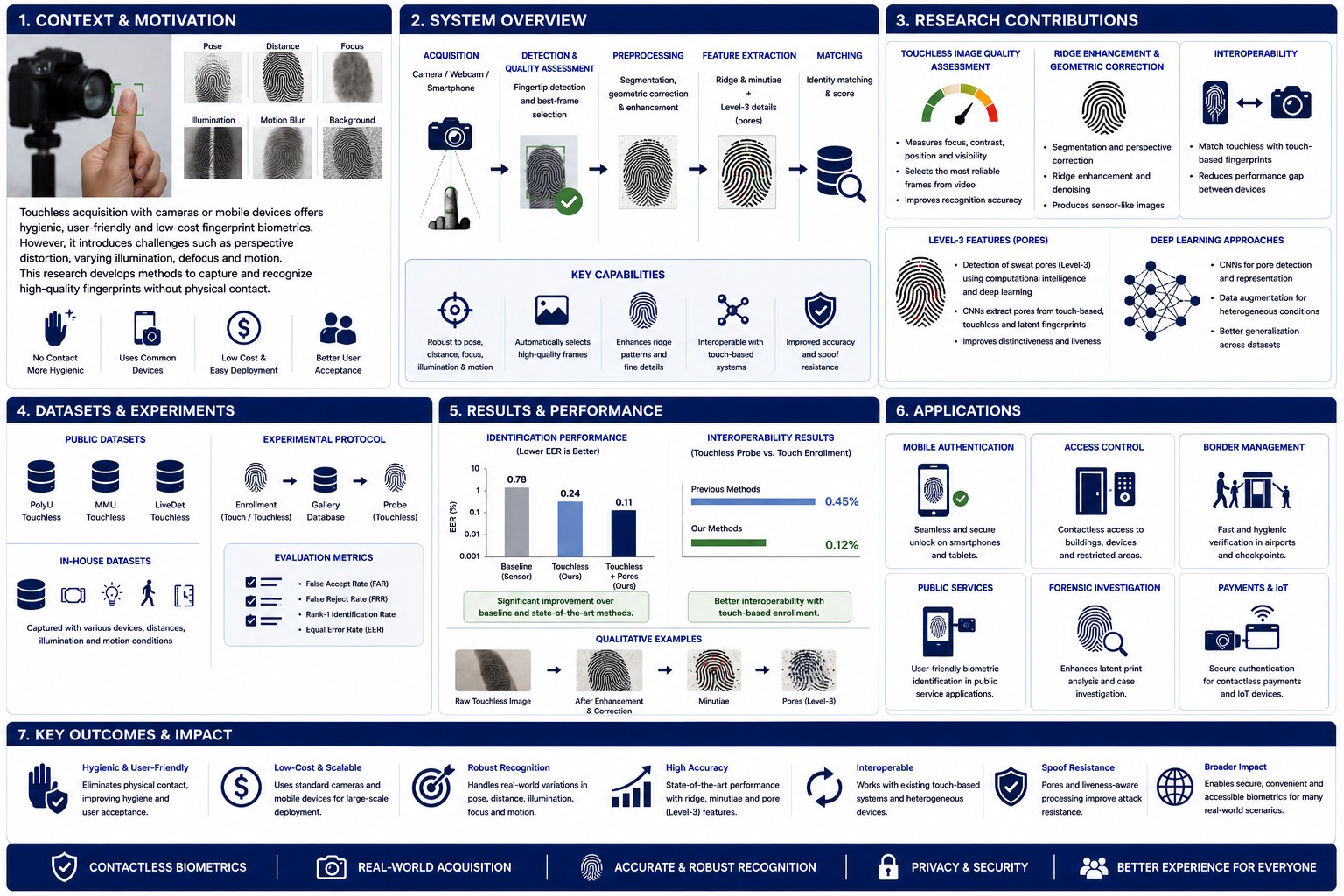
Touchless 2D Fingerprint Recognition is a research activity aimed at replacing conventional contact-based fingerprint sensors with cameras and other general-purpose imaging devices. Traditional systems require users to press a finger against an acquisition surface, which can introduce nonlinear skin deformation, produce samples affected by pressure and moisture, leave latent fingerprints on the sensor, and raise hygiene or user-acceptance concerns. Touchless acquisition avoids physical contact and can use low-cost devices already integrated into laptops and mobile phones, making fingerprint biometrics more accessible and convenient.
The absence of contact, however, introduces a different set of technical challenges. Camera-acquired fingerprints can exhibit perspective distortion, scale and rotation variations, nonuniform illumination, complex backgrounds, limited ridge contrast, defocus, and motion blur. The developed recognition pipeline therefore includes fingertip detection, segmentation of the fingerprint region, geometric normalisation, image enhancement, registration, feature extraction, and identity matching. Dedicated quality-assessment methods analyse individual video frames and automatically select those in which the ridge pattern is sufficiently visible, correctly positioned, and sharply focused.
Early research demonstrated that images acquired using ordinary webcams could be processed to resemble samples produced by dedicated sensors, allowing existing fingerprint matchers to be reused. Subsequent methods improved interoperability between touchless and touch-based samples by correcting the different geometric and photometric characteristics of the images. This is particularly important when users are enrolled with a conventional sensor but later verified using a camera or smartphone.
The project also explored increasingly distinctive fingerprint features. In addition to global ridge flow and minutiae, it introduced computational-intelligence and deep-learning approaches for detecting sweat pores, known as Level-3 features, in touchless images. Convolutional neural networks were later designed to extract pore coordinates from heterogeneous touch-based, touchless, and latent fingerprints using a common method. These fine details can improve recognition accuracy in high-resolution samples and may also contribute to liveness detection and presentation-attack resistance.
Overall, the research provides a complete technological foundation for contactless 2D fingerprint biometrics, ranging from inexpensive acquisition and real-time quality control to robust preprocessing and advanced feature extraction. Its results are relevant to mobile authentication, access control, automated border management, public services, and other applications requiring hygienic, rapid, and user-friendly identity verification without specialised contact sensors.
The absence of contact, however, introduces a different set of technical challenges. Camera-acquired fingerprints can exhibit perspective distortion, scale and rotation variations, nonuniform illumination, complex backgrounds, limited ridge contrast, defocus, and motion blur. The developed recognition pipeline therefore includes fingertip detection, segmentation of the fingerprint region, geometric normalisation, image enhancement, registration, feature extraction, and identity matching. Dedicated quality-assessment methods analyse individual video frames and automatically select those in which the ridge pattern is sufficiently visible, correctly positioned, and sharply focused.
Early research demonstrated that images acquired using ordinary webcams could be processed to resemble samples produced by dedicated sensors, allowing existing fingerprint matchers to be reused. Subsequent methods improved interoperability between touchless and touch-based samples by correcting the different geometric and photometric characteristics of the images. This is particularly important when users are enrolled with a conventional sensor but later verified using a camera or smartphone.
The project also explored increasingly distinctive fingerprint features. In addition to global ridge flow and minutiae, it introduced computational-intelligence and deep-learning approaches for detecting sweat pores, known as Level-3 features, in touchless images. Convolutional neural networks were later designed to extract pore coordinates from heterogeneous touch-based, touchless, and latent fingerprints using a common method. These fine details can improve recognition accuracy in high-resolution samples and may also contribute to liveness detection and presentation-attack resistance.
Overall, the research provides a complete technological foundation for contactless 2D fingerprint biometrics, ranging from inexpensive acquisition and real-time quality control to robust preprocessing and advanced feature extraction. Its results are relevant to mobile authentication, access control, automated border management, public services, and other applications requiring hygienic, rapid, and user-friendly identity verification without specialised contact sensors.
Relevant publications
R. Donida Labati, F. Scotti, Fingerprint, Encyclopedia of Cryptography, Security and Privacy, pp. 1--6, Springer Berlin Heidelberg, Berlin, Heidelberg, January 2021, ISSN 978-3-642-27739-9.
R. Donida Labati, A. Genovese, E. Muñoz, V. Piuri, F. Scotti, A novel pore extraction method for heterogeneous fingerprint images using Convolutional Neural Networks, Pattern Recognition Letters, vol. 113, pp. 58-66, October 2018, ISSN 0167-8655.
A. Genovese, E. Muñoz, V. Piuri, F. Scotti, G. Sforza, Towards touchless pore fingerprint biometrics: a neural approach, Proc. of the 2016 IEEE Congress on Evolutionary Computation (CEC 2016), pp. 4265-4272, Vancouver, BC, Canada, July 2016, ISSN 978-1-5090-0623-6.
R. Donida Labati, Contactless Fingerprint Biometrics: Acquisition, Processing, and Privacy Protection, Ph.D. Dissertation, Universita' degli Studi di Milano, Italy, February 2013.
R. Donida Labati, F. Scotti, Fingerprint, Encyclopedia of Cryptography and Security (2nd ed.), pp. 460-465, Springer, 2011, ISSN 978-1-4419-5905-8.
R. Donida Labati, A. Genovese, V. Piuri, F. Scotti, Measurement of the principal singular point in contact and contactless fingerprint images by using computational intelligence techniques, Proc. of the 2010 IEEE Int. Conf. on Computational Intelligence for Measurement Systems and Applications (CIMSA 2010), pp. 18-23, Taranto, Italy, September 2010, ISSN 978-1-4244-7228-4.
R. Donida Labati, V. Piuri, F. Scotti, Neural-based quality measurement of fingerprint images in contactless biometric systems, Proc. of the 2010 IEEE-INNS Int. Joint Conf. on Neural Networks (IJCNN 2010), pp. 1-8, Barcelona, Spain, July 2010, ISSN 978-1-4244-6916-1.
V. Piuri, F. Scotti, Fingerprint biometrics via low-cost sensors and webcams, Proc. of the 2008 IEEE Int. Conf. on Biometrics: Theory, Applications and Systems (BTAS 2008), pp. 1-6, Washington, D.C., USA, September 2008, ISSN 978-1-4244-2729-1.