
A. Genovese, V. Piuri, F. Scotti, Towards explainable face aging with Generative Adversarial Networks, Proc. of the 26th IEEE Int. Conf. on Image Processing (ICIP 2019), pp. 3806-3810, Taipei, Taiwan, September 2019, ISSN 978-1-5386-6249-6.
Biometric systems
Soft Biometrics
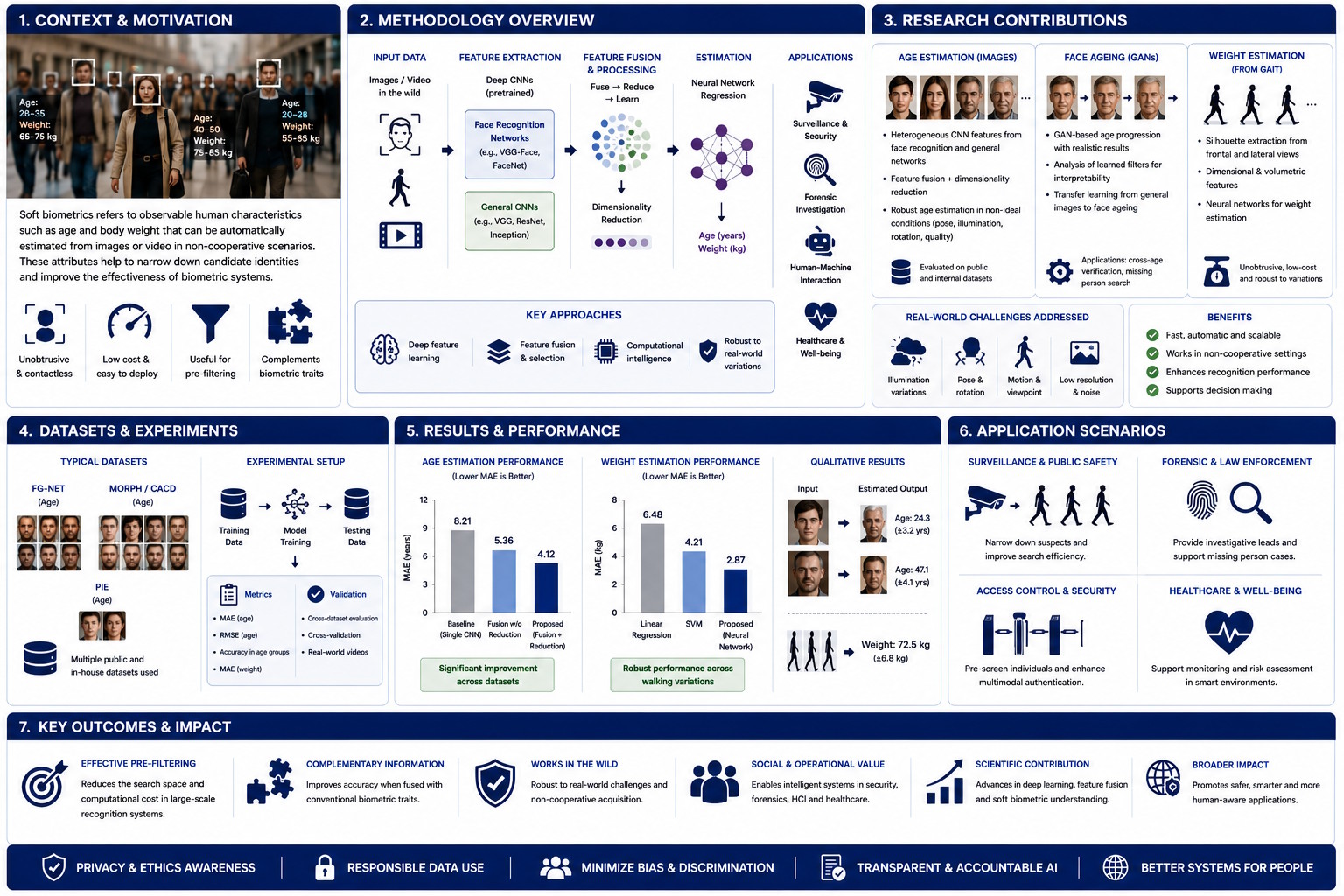
Soft Biometrics is a research activity focused on estimating personal characteristics that are visually observable but are generally less distinctive and permanent than traditional biometric traits such as fingerprints or iris patterns. Examples include age, body weight, height, gender and other physiological or behavioural attributes. Although these characteristics are usually insufficient for reliable identification on their own, they can substantially reduce the number of candidate identities, support forensic investigations and improve the accuracy of multimodal recognition systems. Their main advantage is that they can often be acquired at a distance, unobtrusively and with limited cooperation from the observed individual.
One line of research addressed automatic age estimation from facial images acquired under non-ideal conditions. The proposed approach uses heterogeneous convolutional neural networks pretrained for face recognition and general object classification as feature extractors, without requiring expensive network retraining or fine-tuning. The extracted representations are fused, reduced in dimensionality and processed by a feed-forward neural network to estimate the subject’s age. Experiments on public and internally acquired datasets showed that this strategy can achieve competitive results even when images are affected by pose variations, rotations, uncontrolled illumination and limited quality.
The project also investigated face ageing and age progression using generative adversarial networks. In addition to producing realistic transformations, the research examined the internal filters learned by different GANs to make their operation more interpretable. The proposed analysis showed that face-ageing networks partly reuse general-purpose image-processing operators and that models initially trained on heterogeneous image domains can be adapted to facial ageing through transfer learning and fine-tuning. This work contributes to more explainable generative systems for applications such as cross-age verification, forensic analysis and the search for missing persons.
A complementary activity studied contactless body-weight estimation from video sequences of walking individuals. Silhouettes extracted from synchronised frontal and lateral cameras are used to derive dimensional and approximate volumetric features, which are then processed by neural networks to estimate weight. The method was designed to be low-cost, unobtrusive and robust to walking direction, position and illumination, without requiring direct contact with a scale or an explicit complex model of individual body parts.
Overall, the project demonstrates how soft biometric information can enrich conventional recognition systems by providing fast, non-invasive and context-aware descriptions of individuals. The proposed techniques are relevant to surveillance, border control, security, forensic investigation, ambient intelligence and human–machine interaction, while also highlighting the importance of responsible use because such attributes can be inferred remotely from ordinary images and videos.
One line of research addressed automatic age estimation from facial images acquired under non-ideal conditions. The proposed approach uses heterogeneous convolutional neural networks pretrained for face recognition and general object classification as feature extractors, without requiring expensive network retraining or fine-tuning. The extracted representations are fused, reduced in dimensionality and processed by a feed-forward neural network to estimate the subject’s age. Experiments on public and internally acquired datasets showed that this strategy can achieve competitive results even when images are affected by pose variations, rotations, uncontrolled illumination and limited quality.
The project also investigated face ageing and age progression using generative adversarial networks. In addition to producing realistic transformations, the research examined the internal filters learned by different GANs to make their operation more interpretable. The proposed analysis showed that face-ageing networks partly reuse general-purpose image-processing operators and that models initially trained on heterogeneous image domains can be adapted to facial ageing through transfer learning and fine-tuning. This work contributes to more explainable generative systems for applications such as cross-age verification, forensic analysis and the search for missing persons.
A complementary activity studied contactless body-weight estimation from video sequences of walking individuals. Silhouettes extracted from synchronised frontal and lateral cameras are used to derive dimensional and approximate volumetric features, which are then processed by neural networks to estimate weight. The method was designed to be low-cost, unobtrusive and robust to walking direction, position and illumination, without requiring direct contact with a scale or an explicit complex model of individual body parts.
Overall, the project demonstrates how soft biometric information can enrich conventional recognition systems by providing fast, non-invasive and context-aware descriptions of individuals. The proposed techniques are relevant to surveillance, border control, security, forensic investigation, ambient intelligence and human–machine interaction, while also highlighting the importance of responsible use because such attributes can be inferred remotely from ordinary images and videos.
Relevant publications
A. Anand, R. Donida Labati, A. Genovese, E. Muñoz, V. Piuri, F. Scotti, Age estimation based on face images and pre-trained Convolutional Neural Networks, Proc. of the 2017 IEEE Symp. on Computational Intelligence for Security and Defense Applications (CISDA 2017), pp. 1-7, Honolulu, HI, USA, November 2017, ISSN 978-1-5386-2726-6.
A. Anand, R. Donida Labati, M. Hanmandlu, V. Piuri, F. Scotti, Text-independent speaker recognition for ambient intelligence applications by using information set features, Proc. of the 2017 IEEE Int. Conf. on Computational Intelligence and Virtual Environments for Measurement Systems and Applications (CIVEMSA 2017), pp. 30-35, Annecy, France, July 2017, ISSN 978-1-5090-4253-1.
Y. Zhai, J. Liu, J. Zeng, V. Piuri, F. Scotti, Z. Ying, Y. Xu, J. Gan, Deep Convolutional Neural Network for facial expression recognition, Proc. of the Int. Conf. on Image and Graphics (ICIG 2017), pp. 211-223, Springer, 2017, ISSN 978-3-319-71607-7.
R. Donida Labati, A. Genovese, V. Piuri, F. Scotti, Weight estimation from frame sequences using computational intelligence techniques, Proc. of the 2012 IEEE Int. Conf. on Computational Intelligence for Measurement Systems and Applications (CIMSA 2012), pp. 29-34, Tianjin, China, July 2012, ISSN 978-1-4577-1777-2.