
R. Donida Labati, A. Genovese, V. Piuri, F. Scotti, Two-view contactless fingerprint acquisition systems: a case study for clay artworks, Proc. of the 2012 IEEE Workshop on Biometric Measurements and Systems for Security and Medical Applications (BioMS 2012), pp. 1-8, Salerno, Italy, September 2012, ISSN 978-1-4673-2722-0.
Biometric systems
3D Latent and Ancient Fingerprints
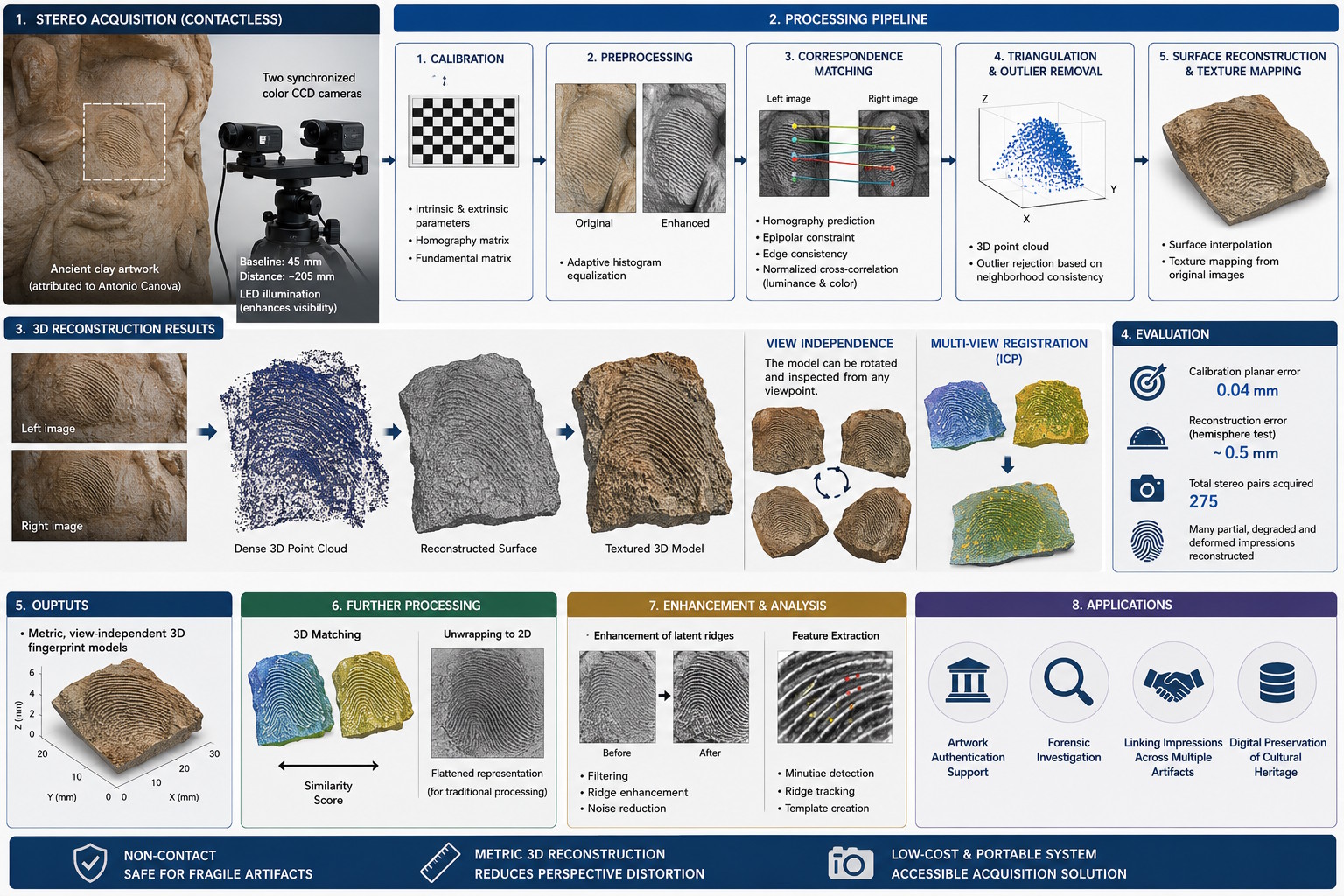
The 3D Latent and Ancient Fingerprints project investigates contactless methods for acquiring and analysing fingerprints preserved on ancient clay artworks. Such impressions can provide valuable evidence when assessing the authenticity of sculptures, since artists often modelled preliminary clay studies by hand and left portions of their ridge patterns on the surface. These traces may potentially be compared with fingerprints associated with other works by the same artist.
Conventional forensic acquisition techniques based on powders, films, moulds, or direct contact are frequently unsuitable for valuable or fragile artefacts. Fingerprints may also lie on irregular or difficult-to-reach regions, while ageing, humidity, material composition, surface deformation, and colour variations can reduce ridge visibility.
Ordinary photographs offer a non-contact alternative, but single-view images can suffer from strong perspective distortion. They may not provide a reliable metric estimate of fingerprint dimensions, particularly when the impression lies on a curved or irregular surface.
The project therefore proposes a portable and comparatively inexpensive system based on two synchronized colour cameras. A single stereo acquisition is used to obtain a metric three-dimensional reconstruction of the fingerprint-bearing surface, reducing dependence on camera orientation and observation viewpoint.
The processing pipeline begins with offline camera calibration using multiple images of a chessboard pattern. Intrinsic and extrinsic parameters, the homography matrix, and the fundamental matrix are estimated to support geometrically constrained correspondence search and metric triangulation.
After acquisition, adaptive histogram equalisation enhances local details that may otherwise be difficult to distinguish on aged clay. Reference points are sampled from one image and matched with candidate points in the second view.
Matching combines homography-based prediction, epipolar constraints, edge consistency, and normalized cross-correlation computed on luminance and colour channels. These checks reduce incorrect correspondences caused by surface irregularities, weak texture, and illumination variations.
The validated correspondences are rectified and triangulated to produce a three-dimensional point cloud. Spatial outliers are removed by checking the consistency of neighbouring points, improving the regularity of the reconstructed surface.
A continuous surface is then estimated through interpolation, and texture information from the original images is mapped onto the reconstructed geometry. The resulting model combines surface shape and visible fingerprint detail in a single metric representation.
Unlike a conventional photograph, the reconstructed model can be rotated and inspected from more suitable viewpoints. Separate acquisitions can also be registered using the Iterative Closest Point algorithm, allowing corresponding surface fragments to be aligned despite differences in camera position.
The method was evaluated on a clay artwork attributed by experts to the Italian sculptor Antonio Canova and considered a possible study for the Ninfa Dormiente. The surface contained numerous partial, distorted, and degraded fingerprint impressions.
The experimental setup used two synchronized Sony colour CCD cameras, a baseline of 45 mm, and an acquisition distance of approximately 205 mm. Simple LED illumination was used only to improve the visibility of selected surface areas; no specialised structured-light apparatus was required.
Calibration tests produced a reported planar reconstruction error of 0.04 mm. A further test using a hemisphere with a known radius produced an approximate reconstruction error of 0.5 mm.
A total of 275 stereo image pairs were captured under different viewpoints and illumination conditions, covering the ancient fingerprint impressions visible on the artwork. The reconstructed models provided metric and view-independent representations that were less distorted than the corresponding single-camera images.
Many impressions were too partial, degraded, or deformed to support reliable personal identification. However, some reconstructed fragments retained sufficient ridge information to make future comparison with impressions from other works technically plausible.
The reconstructed surfaces can be processed directly using three-dimensional matching techniques or unwrapped to produce two-dimensional fingerprint representations compatible with conventional forensic images and contact-based templates. Enhancement methods for latent fingerprints can then be applied to improve ridge visibility.
The work does not claim to provide a complete automatic artwork-authentication system. Authentication remains an interdisciplinary activity involving art historians and forensic specialists, while the proposed method supplies improved acquisition data for subsequent expert analysis.
Overall, the project demonstrates the feasibility of using low-cost stereo vision to preserve and analyse biometric traces embedded in culturally significant objects. Its main contribution is a contactless, metric, and view-independent reconstruction method that reduces perspective distortion while avoiding potentially damaging interaction with fragile surfaces.
Conventional forensic acquisition techniques based on powders, films, moulds, or direct contact are frequently unsuitable for valuable or fragile artefacts. Fingerprints may also lie on irregular or difficult-to-reach regions, while ageing, humidity, material composition, surface deformation, and colour variations can reduce ridge visibility.
Ordinary photographs offer a non-contact alternative, but single-view images can suffer from strong perspective distortion. They may not provide a reliable metric estimate of fingerprint dimensions, particularly when the impression lies on a curved or irregular surface.
The project therefore proposes a portable and comparatively inexpensive system based on two synchronized colour cameras. A single stereo acquisition is used to obtain a metric three-dimensional reconstruction of the fingerprint-bearing surface, reducing dependence on camera orientation and observation viewpoint.
The processing pipeline begins with offline camera calibration using multiple images of a chessboard pattern. Intrinsic and extrinsic parameters, the homography matrix, and the fundamental matrix are estimated to support geometrically constrained correspondence search and metric triangulation.
After acquisition, adaptive histogram equalisation enhances local details that may otherwise be difficult to distinguish on aged clay. Reference points are sampled from one image and matched with candidate points in the second view.
Matching combines homography-based prediction, epipolar constraints, edge consistency, and normalized cross-correlation computed on luminance and colour channels. These checks reduce incorrect correspondences caused by surface irregularities, weak texture, and illumination variations.
The validated correspondences are rectified and triangulated to produce a three-dimensional point cloud. Spatial outliers are removed by checking the consistency of neighbouring points, improving the regularity of the reconstructed surface.
A continuous surface is then estimated through interpolation, and texture information from the original images is mapped onto the reconstructed geometry. The resulting model combines surface shape and visible fingerprint detail in a single metric representation.
Unlike a conventional photograph, the reconstructed model can be rotated and inspected from more suitable viewpoints. Separate acquisitions can also be registered using the Iterative Closest Point algorithm, allowing corresponding surface fragments to be aligned despite differences in camera position.
The method was evaluated on a clay artwork attributed by experts to the Italian sculptor Antonio Canova and considered a possible study for the Ninfa Dormiente. The surface contained numerous partial, distorted, and degraded fingerprint impressions.
The experimental setup used two synchronized Sony colour CCD cameras, a baseline of 45 mm, and an acquisition distance of approximately 205 mm. Simple LED illumination was used only to improve the visibility of selected surface areas; no specialised structured-light apparatus was required.
Calibration tests produced a reported planar reconstruction error of 0.04 mm. A further test using a hemisphere with a known radius produced an approximate reconstruction error of 0.5 mm.
A total of 275 stereo image pairs were captured under different viewpoints and illumination conditions, covering the ancient fingerprint impressions visible on the artwork. The reconstructed models provided metric and view-independent representations that were less distorted than the corresponding single-camera images.
Many impressions were too partial, degraded, or deformed to support reliable personal identification. However, some reconstructed fragments retained sufficient ridge information to make future comparison with impressions from other works technically plausible.
The reconstructed surfaces can be processed directly using three-dimensional matching techniques or unwrapped to produce two-dimensional fingerprint representations compatible with conventional forensic images and contact-based templates. Enhancement methods for latent fingerprints can then be applied to improve ridge visibility.
The work does not claim to provide a complete automatic artwork-authentication system. Authentication remains an interdisciplinary activity involving art historians and forensic specialists, while the proposed method supplies improved acquisition data for subsequent expert analysis.
Overall, the project demonstrates the feasibility of using low-cost stereo vision to preserve and analyse biometric traces embedded in culturally significant objects. Its main contribution is a contactless, metric, and view-independent reconstruction method that reduces perspective distortion while avoiding potentially damaging interaction with fragile surfaces.