R. Donida Labati, A. Genovese, V. Piuri, F. Scotti, Touchless palmprint and fingerprint recognition, Advances in Computing, Informatics, Networking and Cybersecurity - A Book Honoring Prof. Mohammad S. Obaidat’s Significant Scientific Contributions, Lecture Notes in Networks and Systems, vol. 289, pp. 267-298, Springer, Cham, 2022, ISSN 978-3-030-87049-2.
Biometric systems
Touchless 2D Palmprint Recognition
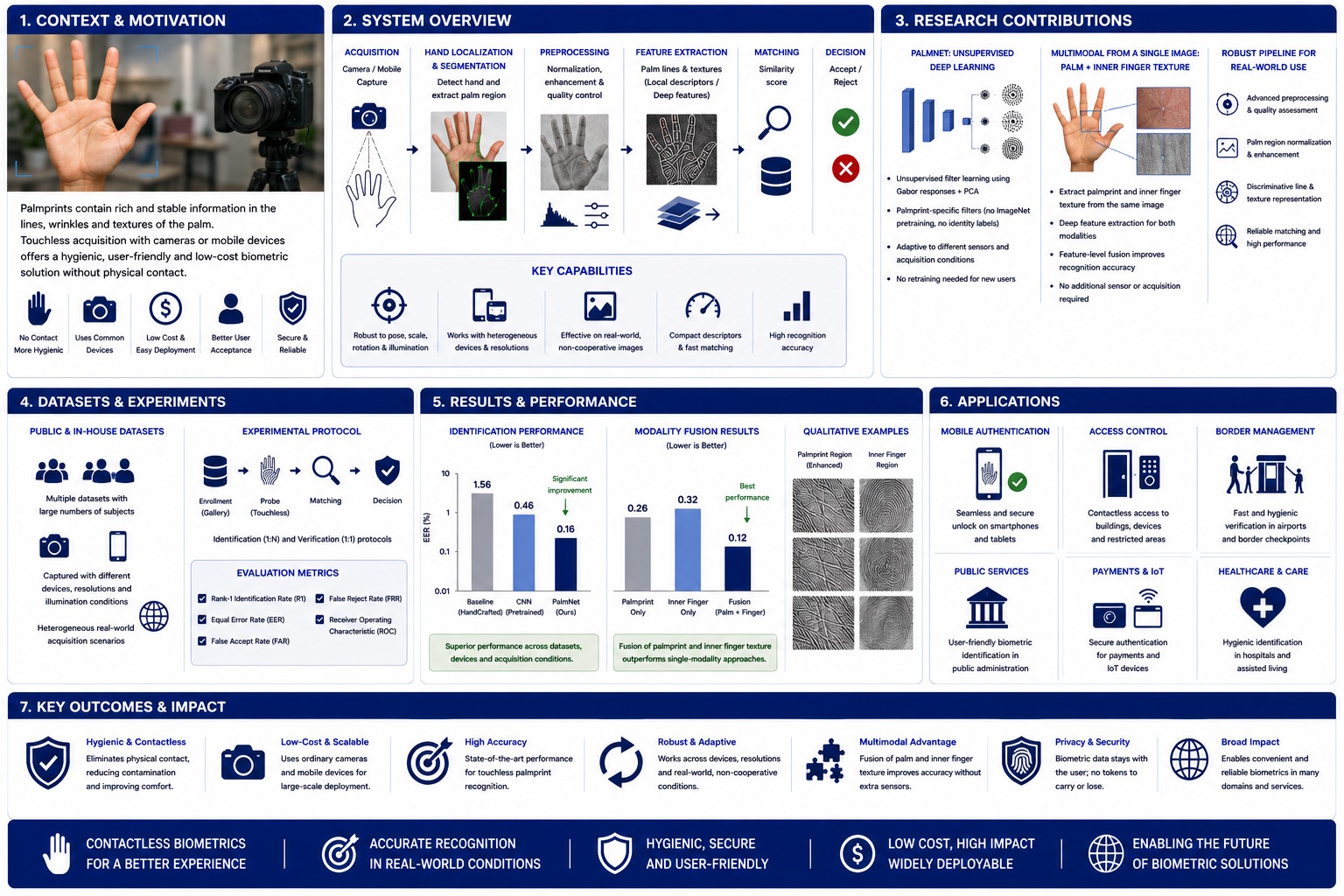
Touchless 2D Palmprint Recognition is a research activity focused on recognising individuals from two-dimensional images of the hand acquired without placing the palm on a physical sensor. Compared with traditional contact-based systems, touchless acquisition can offer greater hygiene, usability and user acceptance while reducing problems caused by skin deformation, pressure, dirty sensors and latent prints. Images can be captured using conventional cameras or mobile devices, making the technology suitable for accessible and less-constrained biometric applications.
The absence of physical contact, however, introduces significant variability. Palm images may differ in scale, rotation, translation, perspective, illumination, resolution and dynamic range, especially when they are captured using heterogeneous devices. The developed processing pipelines therefore include hand localisation, palm-region segmentation, geometric normalisation, image enhancement, extraction of discriminative line and texture information, and biometric matching. Local descriptors and deep-learning methods are designed to remain robust to the variations typically encountered in real-world acquisitions.
A major contribution of the research is PalmNet, a convolutional architecture that learns palmprint-specific filters through an unsupervised procedure based on Gabor responses and principal component analysis. Unlike conventional supervised networks, PalmNet does not require identity labels during filter learning and does not rely on filters pretrained for generic object recognition. Its adaptive filters capture the orientations and textures of palm lines and can be applied to databases acquired with different sensors, resolutions and acquisition procedures. The resulting network produces compact biometric descriptors that can be matched directly and does not need to be retrained whenever new users are enrolled.
The project also investigates multimodal recognition from a single palmar image. In addition to the central palmprint region, the same photograph contains the inner surfaces of the fingers, whose texture provides complementary biometric information. A deep-learning fusion approach trains a common neural architecture separately for palmprint and inner-finger texture and then combines the resulting features. This strategy improves recognition accuracy without requiring a second sensor, another acquisition or additional cooperation from the user.
Overall, the research provides a complete foundation for accurate, contactless and low-cost hand-based recognition. Its results are relevant to mobile authentication, access control, border management, public services and other applications requiring rapid and convenient identity verification with ordinary imaging devices.
The absence of physical contact, however, introduces significant variability. Palm images may differ in scale, rotation, translation, perspective, illumination, resolution and dynamic range, especially when they are captured using heterogeneous devices. The developed processing pipelines therefore include hand localisation, palm-region segmentation, geometric normalisation, image enhancement, extraction of discriminative line and texture information, and biometric matching. Local descriptors and deep-learning methods are designed to remain robust to the variations typically encountered in real-world acquisitions.
A major contribution of the research is PalmNet, a convolutional architecture that learns palmprint-specific filters through an unsupervised procedure based on Gabor responses and principal component analysis. Unlike conventional supervised networks, PalmNet does not require identity labels during filter learning and does not rely on filters pretrained for generic object recognition. Its adaptive filters capture the orientations and textures of palm lines and can be applied to databases acquired with different sensors, resolutions and acquisition procedures. The resulting network produces compact biometric descriptors that can be matched directly and does not need to be retrained whenever new users are enrolled.
The project also investigates multimodal recognition from a single palmar image. In addition to the central palmprint region, the same photograph contains the inner surfaces of the fingers, whose texture provides complementary biometric information. A deep-learning fusion approach trains a common neural architecture separately for palmprint and inner-finger texture and then combines the resulting features. This strategy improves recognition accuracy without requiring a second sensor, another acquisition or additional cooperation from the user.
Overall, the research provides a complete foundation for accurate, contactless and low-cost hand-based recognition. Its results are relevant to mobile authentication, access control, border management, public services and other applications requiring rapid and convenient identity verification with ordinary imaging devices.
Relevant publications
A. Genovese, V. Piuri, K. N. Plataniotis, F. Scotti, PalmNet: Gabor-PCA Convolutional Networks for touchless palmprint recognition, IEEE Transactions on Information Forensics and Security, vol. 14, no. 12, pp. 3160-3174, December 2019, ISSN 1556-6013.
A. Genovese, V. Piuri, F. Scotti, S. Vishwakarma, Touchless palmprint and finger texture recognition: A Deep Learning fusion approach, Proc. of the 2019 IEEE Int. Conf. on Computational Intelligence & Virtual Environments for Measurement Systems and Applications (CIVEMSA 2019), pp. 1-6, Tianjin, China, June 2019, ISSN 978-1-5386-8344-6.