
A. Genovese, Contactless and less-constrained palmprint recognition, Ph.D. Dissertation, Università degli Studi di Milano, Italy, March 2014.
Biometric systems
Touchless 3D Palmprint Recognition
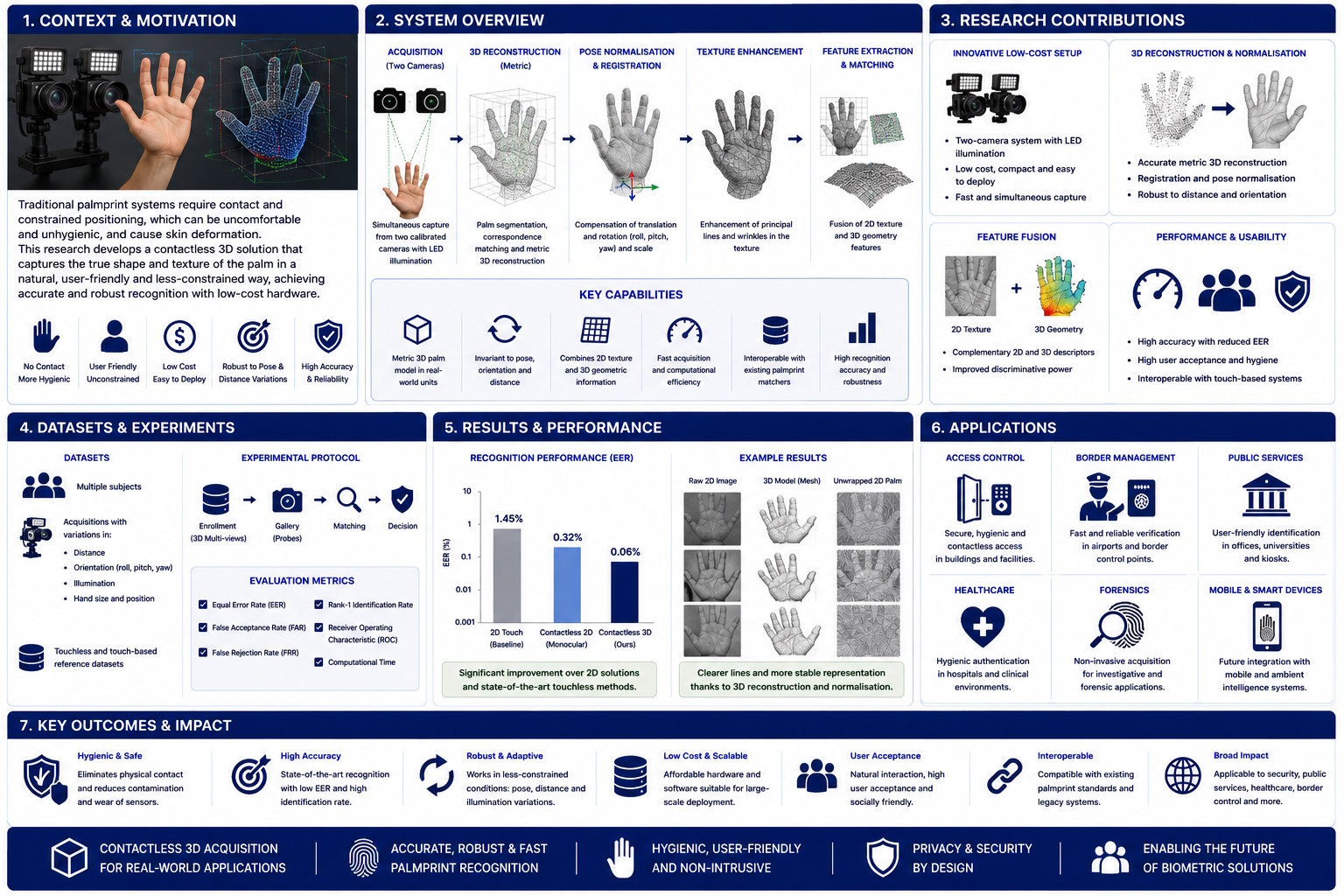
Touchless 3D Palmprint Recognition is a research activity aimed at overcoming the usability limitations of conventional palmprint systems. Traditional devices generally require the user to place the hand on a surface and align it using pegs. This procedure can cause geometric distortions due to pressure, accumulate dirt or latent impressions, and be uncomfortable for elderly users or people with joint or mobility difficulties. The proposed approach instead performs recognition without contact and without requiring the hand to assume a precisely fixed position.
The system uses an innovative, low-cost acquisition device composed of two calibrated cameras and LED illumination. The user only needs to place the open hand approximately horizontally within the common field of view of the cameras; the palm does not touch any surface, and neither the acquisition distance nor the hand orientation needs to be rigidly controlled. Images are captured simultaneously from two viewpoints and processed to segment the palm and determine corresponding image points. These correspondences are then used to reconstruct a metric three-dimensional point cloud and an interpolated surface representing the palm.
The reconstructed model is registered and normalised to compensate for variations in distance, translation, roll, pitch, and other pose differences. Its texture is enhanced to emphasise principal lines, wrinkles, and other distinctive palmprint details. Recognition combines conventional two-dimensional texture descriptors with three-dimensional geometric information, including the shape and curvature of the palm surface. The 3D representation therefore supports more reliable comparison under variable acquisition conditions and provides information unavailable in a single two-dimensional image.
The research progressed from an initial feasibility study using acquisitions at a fixed distance to a fully contactless and less-constrained solution operating with uncontrolled hand distance. Experimental evaluations considered not only recognition accuracy, but also robustness to hand orientation and environmental illumination, computational speed, hardware cost, interoperability, usability, privacy, and social acceptance. The results demonstrated competitive recognition performance and good robustness while using faster and less expensive acquisition hardware than many alternative contactless 3D approaches.
Overall, the project provides an integrated framework covering stereo acquisition, camera calibration, palm segmentation, 3D reconstruction, pose normalisation, texture enhancement, feature extraction, and biometric matching. Its combination of contactless operation, reduced acquisition constraints, low hardware cost, and positive user acceptance makes it relevant to access control, public services, border management, healthcare environments, and other applications requiring hygienic and convenient identity verification.
The system uses an innovative, low-cost acquisition device composed of two calibrated cameras and LED illumination. The user only needs to place the open hand approximately horizontally within the common field of view of the cameras; the palm does not touch any surface, and neither the acquisition distance nor the hand orientation needs to be rigidly controlled. Images are captured simultaneously from two viewpoints and processed to segment the palm and determine corresponding image points. These correspondences are then used to reconstruct a metric three-dimensional point cloud and an interpolated surface representing the palm.
The reconstructed model is registered and normalised to compensate for variations in distance, translation, roll, pitch, and other pose differences. Its texture is enhanced to emphasise principal lines, wrinkles, and other distinctive palmprint details. Recognition combines conventional two-dimensional texture descriptors with three-dimensional geometric information, including the shape and curvature of the palm surface. The 3D representation therefore supports more reliable comparison under variable acquisition conditions and provides information unavailable in a single two-dimensional image.
The research progressed from an initial feasibility study using acquisitions at a fixed distance to a fully contactless and less-constrained solution operating with uncontrolled hand distance. Experimental evaluations considered not only recognition accuracy, but also robustness to hand orientation and environmental illumination, computational speed, hardware cost, interoperability, usability, privacy, and social acceptance. The results demonstrated competitive recognition performance and good robustness while using faster and less expensive acquisition hardware than many alternative contactless 3D approaches.
Overall, the project provides an integrated framework covering stereo acquisition, camera calibration, palm segmentation, 3D reconstruction, pose normalisation, texture enhancement, feature extraction, and biometric matching. Its combination of contactless operation, reduced acquisition constraints, low hardware cost, and positive user acceptance makes it relevant to access control, public services, border management, healthcare environments, and other applications requiring hygienic and convenient identity verification.