
R. Donida Labati, A. Genovese, E. Muñoz, V. Piuri, F. Scotti, 3-D granulometry using image processing, IEEE Transactions on Industrial Informatics, vol. 15, no. 3, pp. 1251-1264, March 2019, ISSN 1551-3203.
Industrial informatics
Innovative Poplar Low Density Structural Panel
IPAN
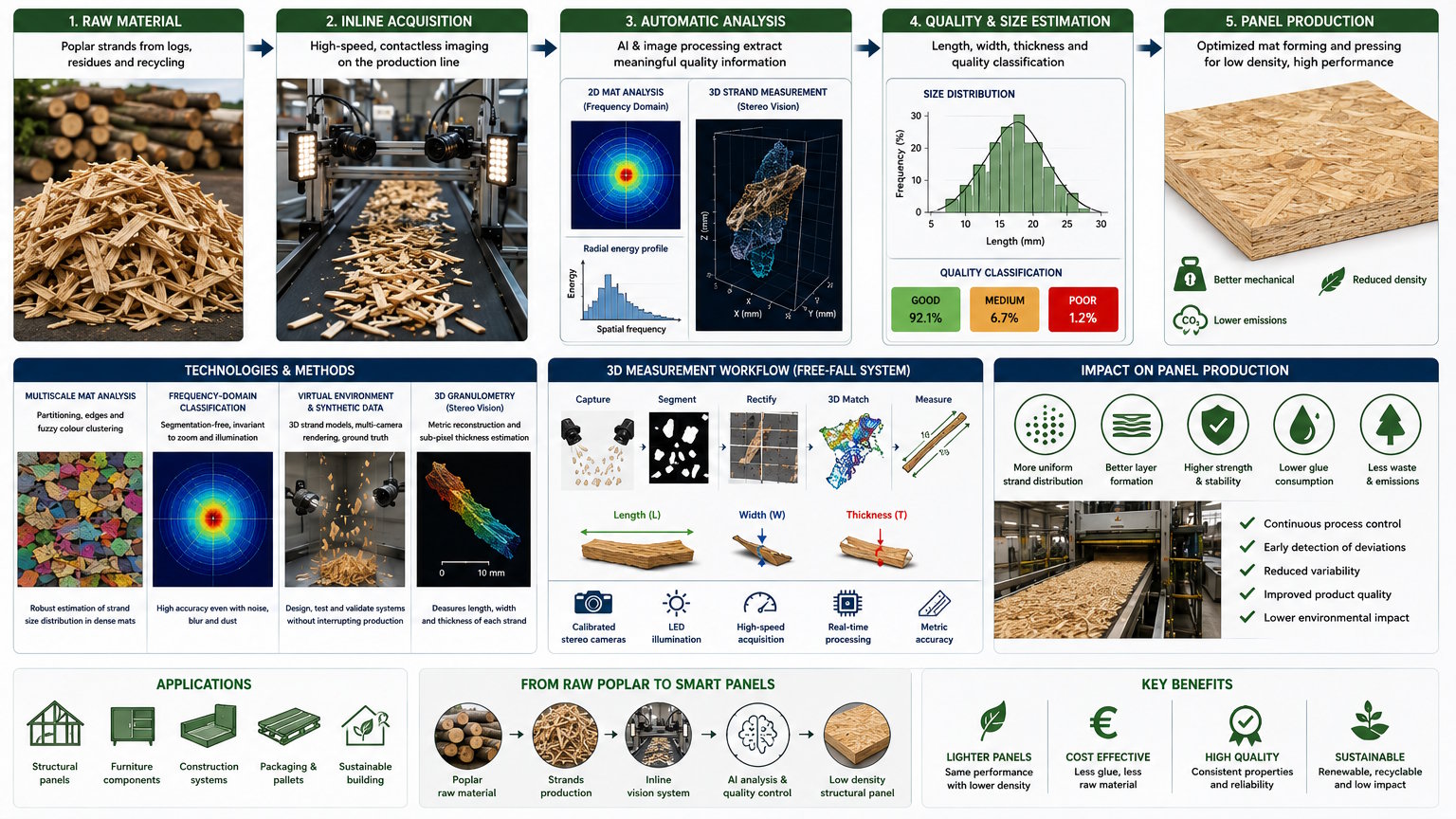
The Innovative Poplar Low Density Structural Panel – I-PAN project was a 36-month research and development initiative co-funded by the European Commission under the Seventh Framework Programme. Its objective was to develop a new generation of lightweight and environmentally friendly engineered-wood panels for structural and furnishing applications.
The proposed panel was designed to use approximately 50% recycled wood and 50% poplar wood, including the upper portions of poplar trees that are commonly underused. This material strategy aimed to reduce pressure on primary forest resources, increase the reuse of wood residues, and improve the sustainability of panel production.
The project addressed the complete manufacturing chain rather than focusing only on the final panel. Its research activities included innovative systems for producing, drying, handling, and metering thin wood strands; the development of a new resin with lower-temperature polymerisation; and improvements in mat forming, blending, and pressing. These innovations were intended to reduce energy consumption, CO₂ emissions, harmful solvents, contaminants, and material waste.
A central technical challenge was controlling the dimensions, orientation, distribution, and quality of the wood strands used to create the panel layers. These properties strongly influence panel density, bonding, mechanical strength, dimensional stability, surface quality, and the quantity of adhesive required during production.
The project therefore developed automatic and contactless computer-vision systems for monitoring wood strands directly on industrial production lines. One approach analysed dense strand mats transported on conveyor belts using multiscale image processing, edge information, and fuzzy colour clustering. The system estimated variations in strand dimensions even when particles touched or overlapped, enabling the early detection of changes in the incoming material.
A complementary segmentation-free method analysed the spatial-frequency content of the complete image. By extracting radial energy profiles from the image spectrum and classifying them using computational-intelligence techniques, the method could distinguish different strand-size distributions without explicitly separating individual particles. This made the analysis more robust to variable illumination, blur, noise, dust, and complex overlapping configurations.
The research also introduced a metric virtual environment for generating realistic synthetic images of falling wood strands. Detailed three-dimensional strand models were randomly positioned and rotated in simulated multi-camera scenes, providing exact reference measurements for the development, calibration, and validation of image-processing and 3D reconstruction algorithms.
The most advanced acquisition system analysed strands during free fall using two synchronized calibrated cameras and commercial LED illumination. Free-fall acquisition reduced occlusions, exposed particles in different orientations, and enabled all three principal dimensions—length, width, and thickness—to be estimated.
The processing pipeline included image segmentation, enhancement, stereo rectification, occlusion management, orientation estimation, metric 3D reconstruction, and sub-pixel thickness measurement. Computational-intelligence models refined the preliminary estimates and adapted the system to different materials, operating conditions, and particle geometries.
The resulting technologies enabled continuous monitoring of strand granulometry and quality without interrupting production. They supported more uniform strand distributions, more stable mat formation, reduced process variability, more efficient use of adhesive, and improved control of the mechanical properties of the final panel.
Overall, I-PAN combined sustainable materials, innovative resins, energy-efficient manufacturing, advanced drying and forming technologies, and intelligent inline inspection. Its main outcome was an integrated approach for producing lightweight structural panels with a high recycled content, lower demand for primary raw materials, reduced emissions and energy consumption, and improved industrial quality control.
The proposed panel was designed to use approximately 50% recycled wood and 50% poplar wood, including the upper portions of poplar trees that are commonly underused. This material strategy aimed to reduce pressure on primary forest resources, increase the reuse of wood residues, and improve the sustainability of panel production.
The project addressed the complete manufacturing chain rather than focusing only on the final panel. Its research activities included innovative systems for producing, drying, handling, and metering thin wood strands; the development of a new resin with lower-temperature polymerisation; and improvements in mat forming, blending, and pressing. These innovations were intended to reduce energy consumption, CO₂ emissions, harmful solvents, contaminants, and material waste.
A central technical challenge was controlling the dimensions, orientation, distribution, and quality of the wood strands used to create the panel layers. These properties strongly influence panel density, bonding, mechanical strength, dimensional stability, surface quality, and the quantity of adhesive required during production.
The project therefore developed automatic and contactless computer-vision systems for monitoring wood strands directly on industrial production lines. One approach analysed dense strand mats transported on conveyor belts using multiscale image processing, edge information, and fuzzy colour clustering. The system estimated variations in strand dimensions even when particles touched or overlapped, enabling the early detection of changes in the incoming material.
A complementary segmentation-free method analysed the spatial-frequency content of the complete image. By extracting radial energy profiles from the image spectrum and classifying them using computational-intelligence techniques, the method could distinguish different strand-size distributions without explicitly separating individual particles. This made the analysis more robust to variable illumination, blur, noise, dust, and complex overlapping configurations.
The research also introduced a metric virtual environment for generating realistic synthetic images of falling wood strands. Detailed three-dimensional strand models were randomly positioned and rotated in simulated multi-camera scenes, providing exact reference measurements for the development, calibration, and validation of image-processing and 3D reconstruction algorithms.
The most advanced acquisition system analysed strands during free fall using two synchronized calibrated cameras and commercial LED illumination. Free-fall acquisition reduced occlusions, exposed particles in different orientations, and enabled all three principal dimensions—length, width, and thickness—to be estimated.
The processing pipeline included image segmentation, enhancement, stereo rectification, occlusion management, orientation estimation, metric 3D reconstruction, and sub-pixel thickness measurement. Computational-intelligence models refined the preliminary estimates and adapted the system to different materials, operating conditions, and particle geometries.
The resulting technologies enabled continuous monitoring of strand granulometry and quality without interrupting production. They supported more uniform strand distributions, more stable mat formation, reduced process variability, more efficient use of adhesive, and improved control of the mechanical properties of the final panel.
Overall, I-PAN combined sustainable materials, innovative resins, energy-efficient manufacturing, advanced drying and forming technologies, and intelligent inline inspection. Its main outcome was an integrated approach for producing lightweight structural panels with a high recycled content, lower demand for primary raw materials, reduced emissions and energy consumption, and improved industrial quality control.
Relevant publications
R. Donida Labati, A. Genovese, E. Muñoz, V. Piuri, F. Scotti, G. Sforza, Analyzing images in frequency domain to estimate the quality of wood particles in OSB production, Proc. of the 2016 IEEE Int. Conf. on Computational Intelligence and Virtual Environments for Measurement Systems and Applications (CIVEMSA 2016), pp. 1-6, Budapest, Hungary, June 2016, ISSN 978-1-4673-9759-9.
R. Donida Labati, A. Genovese, E. Muñoz, V. Piuri, F. Scotti, G. Sforza, Improving OSB wood panel production by vision-based systems for granulometric estimation, Proc. of the 1st Int. Forum on Research and Technologies for Society and Industry - Leveraging a better tomorrow (RTSI 2015), pp. 557-562, Turin, Italy, September 2015, ISSN 978-1-4673-8166-6.
R. Donida Labati, A. Genovese, V. Piuri, F. Scotti, A virtual environment for the simulation of 3D wood strands in multiple view systems for the particle size measurements, Proc. of the 2013 IEEE Int. Conf. on Computational Intelligence and Virtual Environments for Measurement Systems and Applications (CIVEMSA 2013), pp. 162-167, Milan, Italy, July 2013, ISSN 978-1-4673-4701-3.
P. Coscia, A. Genovese, V. Piuri, F. Scotti, Granulo-10k: A large-scale benchmark dataset for multiple-view industrial granulometry, Proc. of the 2026 IEEE Int. Conf. on Image Processing (ICIP 2026), pp. 1-6, Tampere, Finland, September 2026, ISSN 979-8-3315-5151-3.