
R. Donida Labati, A. Genovese, V. Piuri, F. Scotti, Wildfire smoke detection using computational intelligence techniques enhanced with synthetic smoke plume generation, IEEE Transactions on Systems, Man and Cybernetics: Systems, vol. 43, no. 4, pp. 1003-1012, July 2013, ISSN 2168-2216.
Environmental informatics
Wildfire Smoke Detection
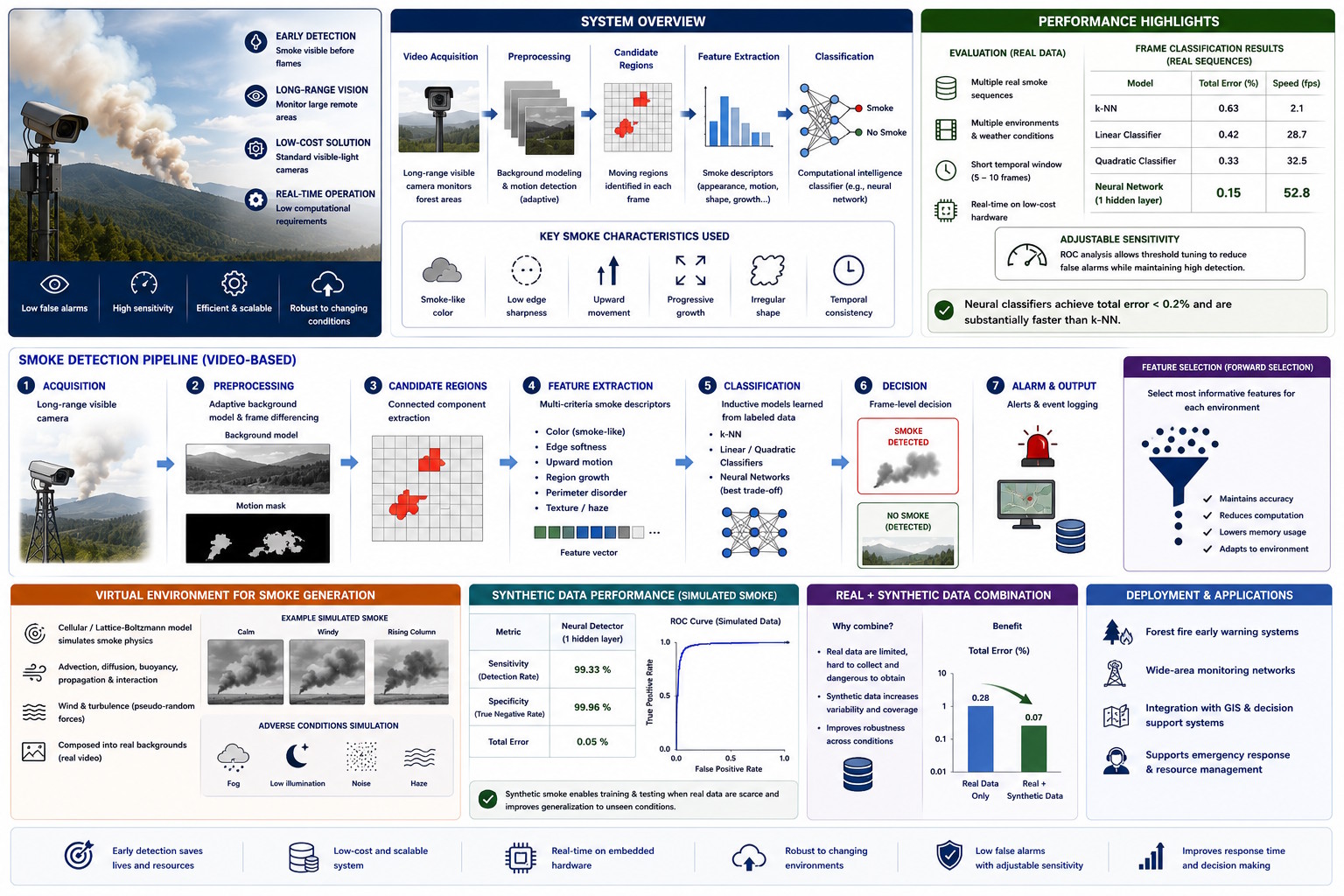
The Wildfire Smoke Detection project investigates automatic methods for identifying forest fires at an early stage through the visual analysis of smoke plumes. Early detection is essential because smoke is often visible at long distances before flames can be observed, giving emergency services more time to assess the event and organise an effective response. Camera-based monitoring also offers a practical alternative to manned observation towers, allowing many remote areas to be supervised from a central location.
The project focuses on low-cost surveillance systems based on conventional visible-light cameras rather than specialised infrared sensors. The proposed methods were designed for low-resolution video, limited computational resources, and real-time or near-real-time operation on affordable hardware. This makes the approach suitable for deployment over large natural areas where installing complex sensing equipment would be impractical or too expensive.
Wildfire smoke detection is challenging because distant plumes may appear faint, partially transparent, and visually similar to clouds, fog, haze, moving vegetation, or illumination changes. Their appearance also varies according to distance, landscape, weather, wind, and camera position. For this reason, the project does not rely on a single visual cue, but combines several physical and temporal characteristics associated with smoke behaviour.
The processing pipeline first identifies candidate moving regions by comparing consecutive frames with adaptively updated background models. These regions are then analysed in terms of smoke-like colour, absence of sharp boundaries, progressive growth, upward motion, and perimeter disorder. Only a short temporal window of approximately five to ten frames is required, limiting memory and processing demands.
Two complementary algorithms were developed. The first performs pixel-level segmentation of smoke regions in each frame, while the second classifies complete frames as containing smoke or not containing smoke. Both algorithms use computational-intelligence classifiers trained on descriptors extracted from the video sequences.
Several classification strategies were evaluated, including linear and quadratic classifiers, k-nearest-neighbour methods, and feed-forward neural networks. Neural networks provided the best balance between accuracy and computational efficiency. In the reported experiments, neural models achieved total frame-classification errors below 0.2% in the considered datasets and were substantially faster than comparable k-nearest-neighbour classifiers.
The approach also includes environment-specific feature selection. A forward-selection procedure identifies the most informative descriptors for each monitored scenario, allowing the system to reduce the original feature set without materially decreasing classification accuracy. This lowers processing time, memory usage, and hardware requirements.
The sensitivity to false alarms can be adjusted through the classifier threshold. Receiver-operating-characteristic analysis showed that the method is robust to false negatives, while the number of false positives can be tuned according to the operational requirements of the monitored area. This is particularly important in environmental surveillance, where excessive alarms can reduce operator confidence.
A major challenge in wildfire research is the scarcity of representative training data. Recording real smoke sequences in the same environment under many weather, illumination, and wind conditions is difficult, expensive, and potentially dangerous. The project therefore developed a virtual environment for generating synthetic wildfire smoke sequences.
The simulator uses a cellular model inspired by lattice-Boltzmann methods to reproduce the principal behaviours of smoke, including advection, diffusion, buoyancy, propagation, and particle interaction. Pseudo-random forces model wind and irregular plume motion, and the generated smoke is composited into real background video.
The virtual environment can also simulate adverse acquisition conditions, including fog, low illumination, image noise, and changing environmental visibility. This makes it possible to test detection algorithms across situations that would be difficult to reproduce safely in the real world.
Experiments showed that classifiers trained and evaluated on synthetic smoke achieved results comparable to those obtained with real smoke sequences. On the reported synthetic dataset, the neural detector achieved approximately 99.33% sensitivity, 99.96% specificity, and a total error of 0.05%. Combining real and synthetic sequences also proved useful when only a limited amount of authentic wildfire footage was available.
The system remained accurate under image noise and reduced illumination, although fog caused a larger performance decrease because it directly reduces smoke visibility. This limitation is intrinsic to visible-light camera systems and highlights the importance of adapting detection thresholds and training data to the environmental context.
The generated smoke sequences were validated both visually and through comparative detection experiments. The results indicated that the synthetic plumes were sufficiently realistic to support the training and evaluation of smoke-detection systems, while increasing their adaptability and generalisation to previously unseen conditions.
Overall, the project combines environmental video surveillance, adaptive background modelling, physical smoke descriptors, feature selection, neural classification, and synthetic-data generation. Its main contribution is a flexible and computationally efficient framework for detecting distant wildfire smoke with inexpensive cameras, while reducing dependence on rare real-fire recordings and supporting deployment across heterogeneous landscapes and weather conditions.
The project focuses on low-cost surveillance systems based on conventional visible-light cameras rather than specialised infrared sensors. The proposed methods were designed for low-resolution video, limited computational resources, and real-time or near-real-time operation on affordable hardware. This makes the approach suitable for deployment over large natural areas where installing complex sensing equipment would be impractical or too expensive.
Wildfire smoke detection is challenging because distant plumes may appear faint, partially transparent, and visually similar to clouds, fog, haze, moving vegetation, or illumination changes. Their appearance also varies according to distance, landscape, weather, wind, and camera position. For this reason, the project does not rely on a single visual cue, but combines several physical and temporal characteristics associated with smoke behaviour.
The processing pipeline first identifies candidate moving regions by comparing consecutive frames with adaptively updated background models. These regions are then analysed in terms of smoke-like colour, absence of sharp boundaries, progressive growth, upward motion, and perimeter disorder. Only a short temporal window of approximately five to ten frames is required, limiting memory and processing demands.
Two complementary algorithms were developed. The first performs pixel-level segmentation of smoke regions in each frame, while the second classifies complete frames as containing smoke or not containing smoke. Both algorithms use computational-intelligence classifiers trained on descriptors extracted from the video sequences.
Several classification strategies were evaluated, including linear and quadratic classifiers, k-nearest-neighbour methods, and feed-forward neural networks. Neural networks provided the best balance between accuracy and computational efficiency. In the reported experiments, neural models achieved total frame-classification errors below 0.2% in the considered datasets and were substantially faster than comparable k-nearest-neighbour classifiers.
The approach also includes environment-specific feature selection. A forward-selection procedure identifies the most informative descriptors for each monitored scenario, allowing the system to reduce the original feature set without materially decreasing classification accuracy. This lowers processing time, memory usage, and hardware requirements.
The sensitivity to false alarms can be adjusted through the classifier threshold. Receiver-operating-characteristic analysis showed that the method is robust to false negatives, while the number of false positives can be tuned according to the operational requirements of the monitored area. This is particularly important in environmental surveillance, where excessive alarms can reduce operator confidence.
A major challenge in wildfire research is the scarcity of representative training data. Recording real smoke sequences in the same environment under many weather, illumination, and wind conditions is difficult, expensive, and potentially dangerous. The project therefore developed a virtual environment for generating synthetic wildfire smoke sequences.
The simulator uses a cellular model inspired by lattice-Boltzmann methods to reproduce the principal behaviours of smoke, including advection, diffusion, buoyancy, propagation, and particle interaction. Pseudo-random forces model wind and irregular plume motion, and the generated smoke is composited into real background video.
The virtual environment can also simulate adverse acquisition conditions, including fog, low illumination, image noise, and changing environmental visibility. This makes it possible to test detection algorithms across situations that would be difficult to reproduce safely in the real world.
Experiments showed that classifiers trained and evaluated on synthetic smoke achieved results comparable to those obtained with real smoke sequences. On the reported synthetic dataset, the neural detector achieved approximately 99.33% sensitivity, 99.96% specificity, and a total error of 0.05%. Combining real and synthetic sequences also proved useful when only a limited amount of authentic wildfire footage was available.
The system remained accurate under image noise and reduced illumination, although fog caused a larger performance decrease because it directly reduces smoke visibility. This limitation is intrinsic to visible-light camera systems and highlights the importance of adapting detection thresholds and training data to the environmental context.
The generated smoke sequences were validated both visually and through comparative detection experiments. The results indicated that the synthetic plumes were sufficiently realistic to support the training and evaluation of smoke-detection systems, while increasing their adaptability and generalisation to previously unseen conditions.
Overall, the project combines environmental video surveillance, adaptive background modelling, physical smoke descriptors, feature selection, neural classification, and synthetic-data generation. Its main contribution is a flexible and computationally efficient framework for detecting distant wildfire smoke with inexpensive cameras, while reducing dependence on rare real-fire recordings and supporting deployment across heterogeneous landscapes and weather conditions.
Relevant publications
A. Genovese, R. Donida Labati, V. Piuri, F. Scotti, Wildfire smoke detection using computational intelligence techniques, Proc. of the 2011 IEEE Int. Conf. on Computational Intelligence for Measurement Systems and Applications (CIMSA 2011), pp. 1-6, Ottawa, ON, Canada, September 2011, ISSN 978-1-61284-924-9.
A. Genovese, R. Donida Labati, V. Piuri, F. Scotti, Virtual environment for synthetic smoke clouds generation, Proc. of the 2011 IEEE Int. Conf. on Virtual Environments, Human-Computer Interfaces and Measurement Systems (VECIMS 2011), pp. 1-6, Ottawa, ON, Canada, September 2011, ISSN 978-1-61284-888-4.