
C. Alippi, G. D'Angelo, M. Matteucci, G. Pasquettaz, V. Piuri, F. Scotti, Composite techniques for quality analysis in automotive laser welding, Proc. of the 2003 IEEE Int. Comference on Computational Intelligence for Measurement Systems and Applications (CIMSA 2003), pp. 72-77, Lugano, Switzerland, July 2003, ISSN 0-7803-7783-4.
Industrial informatics
Laser Weld Inspection
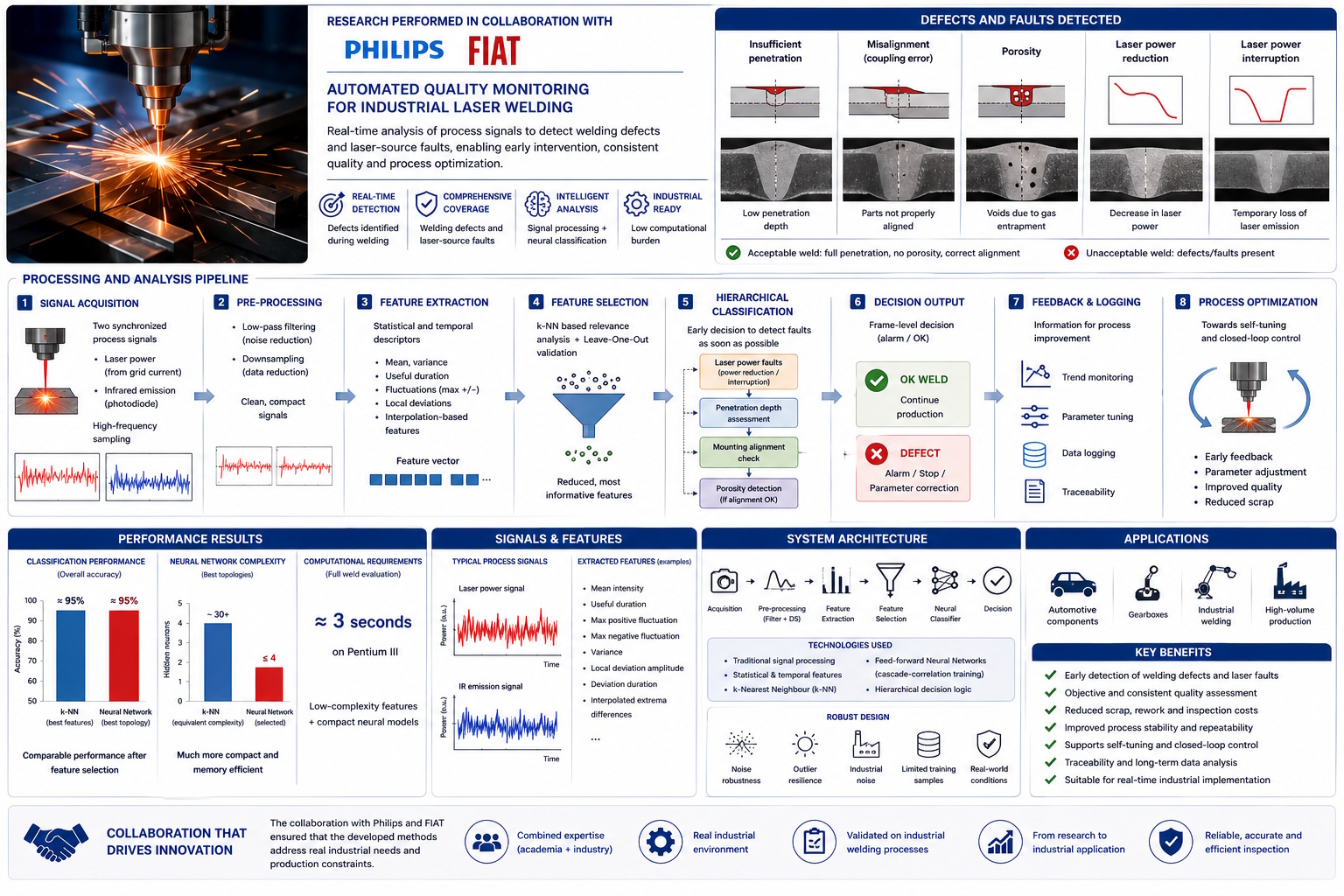
The Laser Weld Inspection project investigates automated quality analysis for industrial laser welding, with particular attention to automotive manufacturing. The research was performed in collaboration with Philips and FIAT, bringing together academic methods in signal processing and computational intelligence with industrial expertise in laser systems, production processes, and automotive components.
Laser welding enables fast, precise, and highly automated joining with limited heat input. However, the process is sensitive to small variations in laser power, component positioning, surface cleanliness, and joint geometry. Because keyhole welding behaves as a threshold process, relatively small changes near the operating point can produce substantial variations in weld penetration and final quality.
Conventional quality assessment is generally performed offline on completed components, often using costly ultrasonic inspection. Such procedures are time-consuming and provide limited feedback for correcting the process while production is running. The project therefore proposes an online monitoring framework capable of detecting defects directly during welding and providing information useful for process tuning and long-term analysis.
The system targets both welding defects and faults affecting the laser source. The considered conditions include insufficient penetration depth, misalignment of the assembled parts, porosity caused by different physical phenomena, a reduction in laser power, and short interruptions of the laser source.
Two main process signals are acquired during welding: the laser-power signal, derived from the grid current, and the infrared radiation emitted by the welding process. The power signal is particularly informative for detecting decreases and interruptions in laser output, whereas the photodiode signal is used to identify penetration problems, component misalignment, and porosity.
The processing pipeline combines conventional signal-processing algorithms with computational-intelligence techniques. High-frequency industrial noise is reduced through low-pass filtering, and the signals are downsampled to reduce the amount of data that must be processed. Statistical and temporal descriptors are then extracted directly from the filtered and unfiltered signals.
Features derived from the laser-power signal include its mean intensity, useful duration, and maximum positive and negative fluctuations. These quantities provide indicators of power reductions and temporary power failures. Mean intensity and variance from the welding signal are instead used to estimate penetration depth.
For porosity and mounting-error detection, the method constructs a local reference signal using cubic interpolation. The amplitude and duration of the principal deviations from this reference are analysed to identify porosity, while differences between characteristic extrema of the interpolated signal provide information about coupling misalignment.
The classification architecture is hierarchical. Laser-power faults and penetration depth are assessed independently, after which the system evaluates whether the component has been mounted correctly. Porosity analysis is activated only when the mounting condition is considered acceptable. This structure allows defects to be identified as early as possible and avoids unnecessary processing.
Because only a limited number of labelled industrial samples were available, the project adopted specialised classifiers for individual defect categories rather than a single highly complex model. The approach simplifies training, supports parallel execution, and makes it possible to tune each module according to the characteristics of a specific error type.
Two classifier families were compared: k-nearest-neighbour models and feed-forward neural networks. Feature relevance was first evaluated using k-nearest-neighbour classification and leave-one-out validation. Redundant descriptors were then removed so that the final classifiers could retain satisfactory accuracy with a reduced computational cost.
The neural classifiers used one hidden layer and were automatically configured through cascade-correlation training. Experiments considered networks with different numbers of hidden neurons and selected the most accurate topology through repeated validation. The best neural models required no more than four hidden neurons, making them substantially more compact than the corresponding instance-based classifiers.
The experimental results showed that neural and k-nearest-neighbour classifiers offered comparable performance once the most informative features had been selected. Neural models were more accurate for mounting-error detection and required less memory and computational effort, so they were selected for the complete monitoring system.
In the reported preliminary implementation, the full quality evaluation of a standard weld required approximately three seconds on a Pentium III computer. The results demonstrated that the combination of low-complexity feature extraction and compact neural models could provide accurate automated inspection while keeping processing requirements bounded.
Overall, the project established a composite methodology for intelligent laser-welding inspection in automotive production. The collaboration with Philips and FIAT ensured that the research was grounded in real industrial processes, realistic fault conditions, and practical production constraints. By combining physical knowledge of the welding process, process-signal analysis, automatic feature reduction, and self-tuned neural classification, the system supports early defect detection, objective quality assessment, and future closed-loop adjustment of industrial welding parameters.
Laser welding enables fast, precise, and highly automated joining with limited heat input. However, the process is sensitive to small variations in laser power, component positioning, surface cleanliness, and joint geometry. Because keyhole welding behaves as a threshold process, relatively small changes near the operating point can produce substantial variations in weld penetration and final quality.
Conventional quality assessment is generally performed offline on completed components, often using costly ultrasonic inspection. Such procedures are time-consuming and provide limited feedback for correcting the process while production is running. The project therefore proposes an online monitoring framework capable of detecting defects directly during welding and providing information useful for process tuning and long-term analysis.
The system targets both welding defects and faults affecting the laser source. The considered conditions include insufficient penetration depth, misalignment of the assembled parts, porosity caused by different physical phenomena, a reduction in laser power, and short interruptions of the laser source.
Two main process signals are acquired during welding: the laser-power signal, derived from the grid current, and the infrared radiation emitted by the welding process. The power signal is particularly informative for detecting decreases and interruptions in laser output, whereas the photodiode signal is used to identify penetration problems, component misalignment, and porosity.
The processing pipeline combines conventional signal-processing algorithms with computational-intelligence techniques. High-frequency industrial noise is reduced through low-pass filtering, and the signals are downsampled to reduce the amount of data that must be processed. Statistical and temporal descriptors are then extracted directly from the filtered and unfiltered signals.
Features derived from the laser-power signal include its mean intensity, useful duration, and maximum positive and negative fluctuations. These quantities provide indicators of power reductions and temporary power failures. Mean intensity and variance from the welding signal are instead used to estimate penetration depth.
For porosity and mounting-error detection, the method constructs a local reference signal using cubic interpolation. The amplitude and duration of the principal deviations from this reference are analysed to identify porosity, while differences between characteristic extrema of the interpolated signal provide information about coupling misalignment.
The classification architecture is hierarchical. Laser-power faults and penetration depth are assessed independently, after which the system evaluates whether the component has been mounted correctly. Porosity analysis is activated only when the mounting condition is considered acceptable. This structure allows defects to be identified as early as possible and avoids unnecessary processing.
Because only a limited number of labelled industrial samples were available, the project adopted specialised classifiers for individual defect categories rather than a single highly complex model. The approach simplifies training, supports parallel execution, and makes it possible to tune each module according to the characteristics of a specific error type.
Two classifier families were compared: k-nearest-neighbour models and feed-forward neural networks. Feature relevance was first evaluated using k-nearest-neighbour classification and leave-one-out validation. Redundant descriptors were then removed so that the final classifiers could retain satisfactory accuracy with a reduced computational cost.
The neural classifiers used one hidden layer and were automatically configured through cascade-correlation training. Experiments considered networks with different numbers of hidden neurons and selected the most accurate topology through repeated validation. The best neural models required no more than four hidden neurons, making them substantially more compact than the corresponding instance-based classifiers.
The experimental results showed that neural and k-nearest-neighbour classifiers offered comparable performance once the most informative features had been selected. Neural models were more accurate for mounting-error detection and required less memory and computational effort, so they were selected for the complete monitoring system.
In the reported preliminary implementation, the full quality evaluation of a standard weld required approximately three seconds on a Pentium III computer. The results demonstrated that the combination of low-complexity feature extraction and compact neural models could provide accurate automated inspection while keeping processing requirements bounded.
Overall, the project established a composite methodology for intelligent laser-welding inspection in automotive production. The collaboration with Philips and FIAT ensured that the research was grounded in real industrial processes, realistic fault conditions, and practical production constraints. By combining physical knowledge of the welding process, process-signal analysis, automatic feature reduction, and self-tuned neural classification, the system supports early defect detection, objective quality assessment, and future closed-loop adjustment of industrial welding parameters.
Relevant publications
C. Alippi, G. D'Angelo, M. Matteucci, G. Pasquettaz, V. Piuri, F. Scotti, A system and method for monitoring laser welds and giving an indication of the quality of welding, European Patent no. EP1371443, April 2003.
C. Alippi, G. D'Angelo, G. Invernizzi, G. Pasquettaz, V. Piuri, System and method for monitoring laser welds, particularly in tailored blanks, European Patent no. EP1361015, April 2003.
C. Alippi, G. D'Aangelo, M. Matteucci, G. Pasquettaz, V. Piuri, F. Scotti, Sistema di monitoraggio per la qualita' di saldature laser in tempo reale (Real-time laser welding monitoring system), Italian Patent No. TO2002A000508, 2002.