
P. Coscia, A. Genovese, V. Piuri, K. N. Plataniotis, F. Scotti, Distributed anomaly detection with attention-guided diffusion models and client-side defect generation, IEEE Systems Journal, vol. 19, no. 4, pp. 1145-1156, December 2025, ISSN 1937-9234.
Industrial informatics
Anomaly Detection
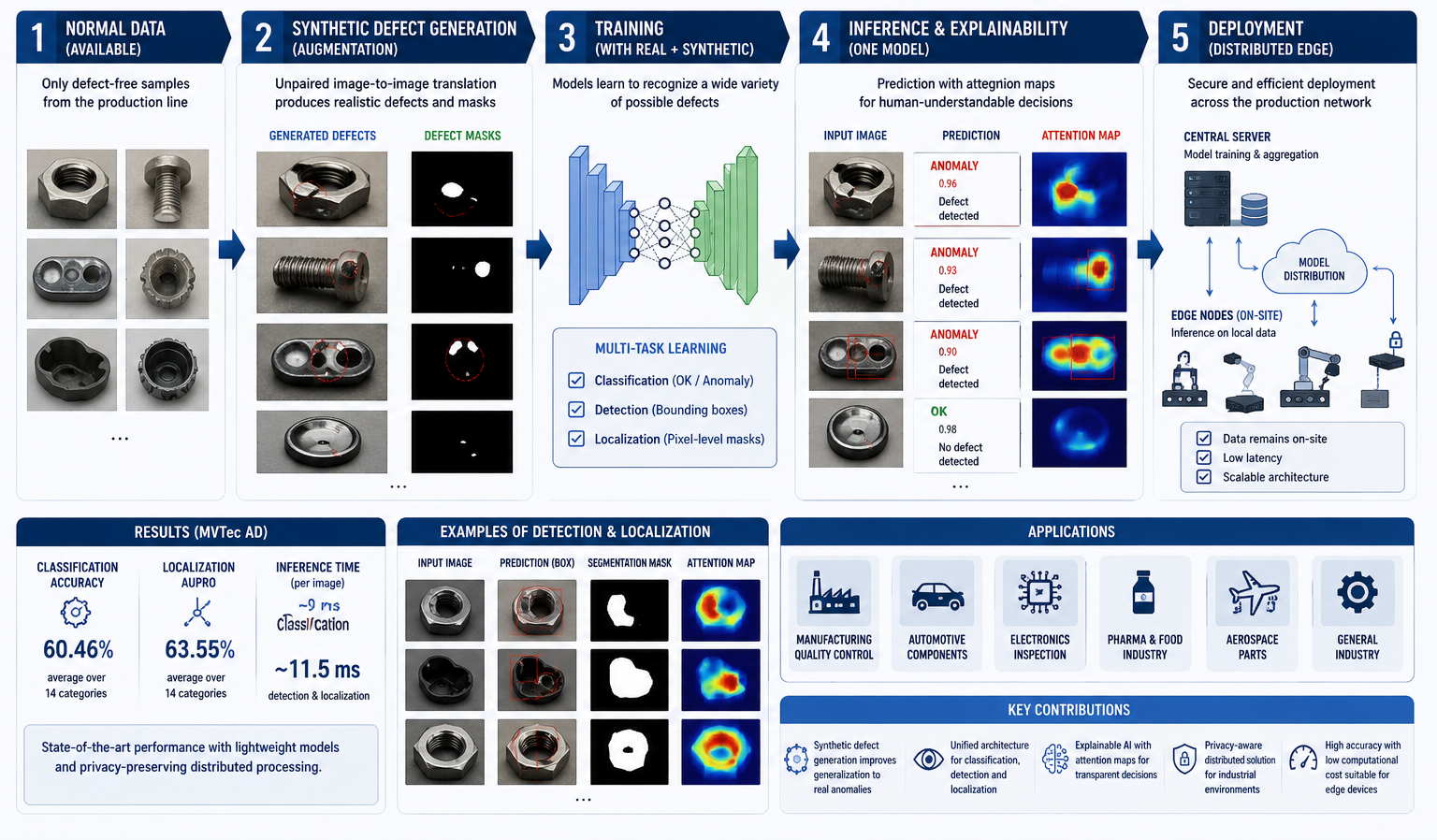
The project investigates artificial-intelligence methods for detecting and localizing visual anomalies in industrial products and manufacturing processes. Automated inspection is essential for ensuring product quality, reducing waste, and promptly identifying components that do not comply with production requirements. However, industrial anomaly detection is especially challenging because defective samples are generally rare, expensive to collect, heterogeneous, and potentially sensitive from the perspective of intellectual property and process confidentiality.
A first research direction addresses low-data operating conditions through synthetic defect generation. An unpaired image-to-image translation architecture transforms defect-free products into realistic defective samples while simultaneously producing segmentation masks that identify the generated anomalous regions. The model uses multiple generation branches and consistency constraints to maintain agreement between the synthetic image and its associated mask. Tests on industrial categories from the MVTec AD dataset show improved defect fidelity and more robust localization than conventional generative baselines. Classifiers trained with these synthetic samples achieve substantially better recognition of real defective products, reaching average accuracies of approximately 88.6% with ResNet-18 and 91.7% with DenseNet-121 in the reported experiments.
A second direction focuses on unified and explainable anomaly detection. The OneN architecture integrates classification, detection, and pixel-level localization within a single guided-attention framework rather than treating them as independent tasks. Attention maps are directly involved in the decision process, providing native visual explanations of the regions that contribute to anomaly predictions. This design improves practical interpretability while reducing the complexity associated with separate task-specific modules. The approach is evaluated on standard industrial anomaly-detection benchmarks, including MVTec AD, with the goal of providing a general model for both product-level decisions and spatial defect localization.
The project also explores anomaly detection in geographically distributed and privacy-sensitive production environments. The D-ADDA framework combines local data augmentation, attention-guided diffusion models, and distributed execution. Sensitive defective images remain at the production site, while only non-sensitive information, such as normal samples or defect masks, may be processed centrally. A superpixel-based augmentation module creates diverse defect configurations, which are subsequently used to train compact diffusion models capable of generating paired anomalous images and masks.
Unlike approaches that rely on large foundation models or external training datasets, D-ADDA is trained on locally available industrial data and uses a substantially smaller backbone. The complete pipeline supports anomaly classification, detection, and localization, and can distribute its components across clients with different data and computational resources. On MVTec AD, the method achieves an average classification accuracy of 60.46% across fourteen categories, outperforming the compared approaches while maintaining competitive localization performance. Individual experiments also show classification accuracy up to 97.92% for the hazelnut category, with efficient inference of approximately 9 ms for classification and 11.5 ms for detection and localization.
Overall, the project delivers a progressive set of techniques for industrial anomaly detection: generative augmentation for scarce-data scenarios, attention-based models for interpretable decisions, and distributed diffusion architectures for privacy-aware inspection. The resulting methods aim to make automatic visual quality control more accurate, explainable, scalable, and suitable for deployment in real manufacturing environments with limited data and computational resources.
A first research direction addresses low-data operating conditions through synthetic defect generation. An unpaired image-to-image translation architecture transforms defect-free products into realistic defective samples while simultaneously producing segmentation masks that identify the generated anomalous regions. The model uses multiple generation branches and consistency constraints to maintain agreement between the synthetic image and its associated mask. Tests on industrial categories from the MVTec AD dataset show improved defect fidelity and more robust localization than conventional generative baselines. Classifiers trained with these synthetic samples achieve substantially better recognition of real defective products, reaching average accuracies of approximately 88.6% with ResNet-18 and 91.7% with DenseNet-121 in the reported experiments.
A second direction focuses on unified and explainable anomaly detection. The OneN architecture integrates classification, detection, and pixel-level localization within a single guided-attention framework rather than treating them as independent tasks. Attention maps are directly involved in the decision process, providing native visual explanations of the regions that contribute to anomaly predictions. This design improves practical interpretability while reducing the complexity associated with separate task-specific modules. The approach is evaluated on standard industrial anomaly-detection benchmarks, including MVTec AD, with the goal of providing a general model for both product-level decisions and spatial defect localization.
The project also explores anomaly detection in geographically distributed and privacy-sensitive production environments. The D-ADDA framework combines local data augmentation, attention-guided diffusion models, and distributed execution. Sensitive defective images remain at the production site, while only non-sensitive information, such as normal samples or defect masks, may be processed centrally. A superpixel-based augmentation module creates diverse defect configurations, which are subsequently used to train compact diffusion models capable of generating paired anomalous images and masks.
Unlike approaches that rely on large foundation models or external training datasets, D-ADDA is trained on locally available industrial data and uses a substantially smaller backbone. The complete pipeline supports anomaly classification, detection, and localization, and can distribute its components across clients with different data and computational resources. On MVTec AD, the method achieves an average classification accuracy of 60.46% across fourteen categories, outperforming the compared approaches while maintaining competitive localization performance. Individual experiments also show classification accuracy up to 97.92% for the hazelnut category, with efficient inference of approximately 9 ms for classification and 11.5 ms for detection and localization.
Overall, the project delivers a progressive set of techniques for industrial anomaly detection: generative augmentation for scarce-data scenarios, attention-based models for interpretable decisions, and distributed diffusion architectures for privacy-aware inspection. The resulting methods aim to make automatic visual quality control more accurate, explainable, scalable, and suitable for deployment in real manufacturing environments with limited data and computational resources.
Relevant publications
P. Coscia, A. Genovese, V. Piuri, F. Scotti, OneN: Guided attention for natively-explainable anomaly detection, Image and Vision Computing, vol. 163, no. 105741, pp. 1-18, November 2025, ISSN 0262-8856.
P. Coscia, A. Genovese, F. Scotti, V. Piuri, Adversarial defect synthesis for industrial products in low data regime, Proc. of the 2023 IEEE Int. Conf. on Image Processing (ICIP 2023), pp. 1360-1364, Kuala Lumpur, Malaysia, October 2023, ISSN 978-1-7281-9835-4.